
The first time I remember learning about the Civil Rights Movement and the people involved, I was in middle school. I had to do a book report on a biography and I chose Coretta Scott King. I was what many would have described as a voracious reader and remember middle school as a time of realization for me about a number of societal issues- historical and modern day. I began developing my personal values and social justice convictions through those stories and books.
However, it was when I entered college at Texas A&M University in the early 1990s, that I first learned about Civil Rights leader, John Lewis. I was particularly taken because he was a teenager when he got involved in the Civil Rights Movement. And when he participated in the Freedom Rides and lead the Student Nonviolent Coordinating Committee, he was the same age as I was in college.
I was enthralled with his bravery and drawn to his commitment, while embarrassed by my relative lack of “doing” at the same age. He ignited in me a dual sense of inspiration and inadequacy, that I still carry today. He was not just a historical figure; at that time, he was still involved in the fight as a Congressperson more than thirty years later. It was even more compelling to me that he had not put his marching shoes away and continued to get into what he called “good trouble.” He continued to march and fight for what he believed.
I wasn’t someone who put Tiger Beat pictures on my walls or obsessed about the latest teen heartthrob. John Lewis was the closest thing for me of a “celebrity crush.” More accurately, I described him as my hero. And I still do today.
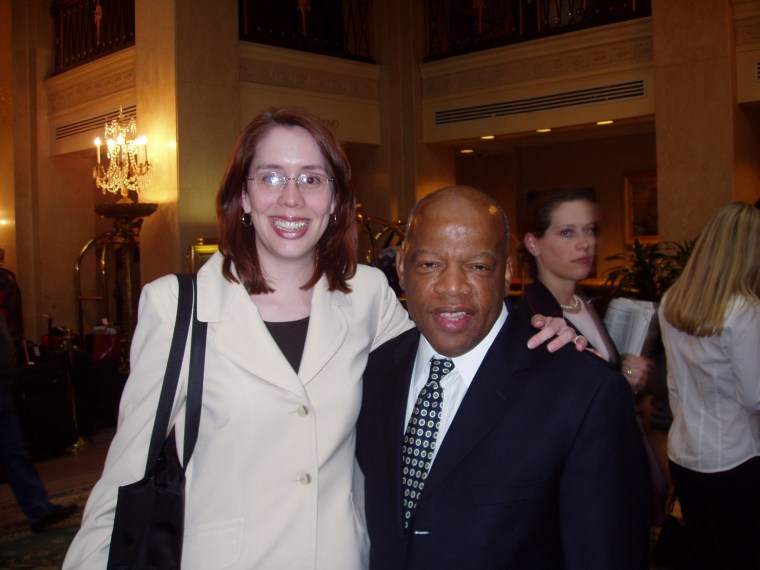
Fast forward to the early 2000s and I was working in education at the ADL. I found out that John Lewis would be speaking at the ADL’s National Leadership Meeting in Washington, DC – an event that education staff did not typically attend. I got permission to hear him speak at an ADL event, if I paid my own way, so I did. And after his speech, I snuck out and ran down the hallway of the hotel to shake his hand and get a picture with him. It was my “fangirl” moment and one of the best memories of my life.
However, I think it is important to reflect a bit more. This shouldn’t be understood just a story of my brush with my favorite “celebrity.” When I first learned about John Lewis, I had the feeling of connection and awe – the realization of what someone so young can accomplish and I think it was natural for me to try to see myself in him. Beyond that, I was taken by the other young people who were at the heart of the Civil Rights Movement. I tried to imagine myself in that space and time. Would I have had the courage that they did? What would I have done in the face of hatred, vitriol and injustice?
Many people look at historical events and imagine themselves as among the heroes. They assume that they would have been on the “right side” of history. The reality is that there were far fewer people engaged in the Civil Rights Movement, or any other resistance movement, than those who either opposed it actively or were complacent.
And that is what I had to come to terms with. I was drawn to my hero because I wanted to see myself in him. I felt motivated by his story because I felt an affinity with his youth. I wanted so much to connect with the cause and relate to the people being oppressed; to relate to my hero. Yet, there was something that I had to reconcile.
My race. My race as group membership. My race as a key element of my experience in the world.
The reality is that my people – white people – are the oppressors in that history. I know that there were white folks who fought alongside black people during the Civil Rights Movement, but to only see myself in them and not in all the people who fought to maintain the status quo through laws, resistance, violence and complacency is dishonest and disingenuous. If I truly wanted to emulate the values of my hero, I first had to acknowledge who I am.
And that has been my journey. To reconcile the ways that I benefit and reinforce white privilege and white supremacy, despite my beliefs and values is ongoing and hard.
And it is mandatory, if I want to honor John Lewis and his legacy of good trouble.
So, the reality is that I don’t know what I would have done in the Civil Rights Movement. It is much easier to cast myself as a character in the past – through a lens of history that makes everything and everyone more neatly defined – than to understand myself as a character in the present- where the view is much murkier.
Mass incarceration of black and brown bodies. Police brutality. Detention camps and children in cages at the border. Racism and xenophobia as foundations to our current immigration policies. Looming prospect of war with Iran. Islamophobia as a foreign policy. Presidential impeachment. Anti-semitic attacks and hate crimes. The loss of protections for LGBTQ+ youth and the rolling back of progress we thought was institutionalized. The ongoing natural disasters in Puerto Rico magnified by the racist policies undergirding US treatment of its citizens. The murder rate of trans women, especially Black trans women.
These and other injustices are all happening now. And that dual sense of inspiration and inadequacy are still with me today. Every day, I don’t know that I am doing enough. And I often allow myself to get stuck in feelings of helplessness. I am not at all sure that the lens of history will view me favorably. That’s the honest truth. And it is also true that I feel compelled to continue to try.
I remain inspired by John Lewis’ life and legacy. I said that John Lewis is a hero. He is. But hero as a noun feels too passive a description. For John Lewis is really defined by doing, by getting into “good trouble.” John Lewis isn’t just a hero, he heroes (active, present tense). He has heroed every day for over 60 years.
And he is a model for how each of us can choose actions to “hero” everyday, too. I endeavor to engage in actions each day that align with my highest ideals and cause “good trouble” – rooted in my identities. with my flaws. with conviction.
I don’t always get it right. I fail a lot.
And with that mixture of inspiration and inadequacy, I promise to try again tomorrow.
 bethreflects
Beautifully written.
John is proud of you!
I am honored that your mom sent me this to read! Moving and beautifully written!
From Gail Shulman