
During the winter season (starting with Halloween), many of the houses in my neighborhood put up holiday lights. During a time when the sun sets early and I’m driving home in the dark, the lights… More
Discomfort: Martin Luther King, Jr Day Reflection 2023

As I reflect on Martin Luther King, Jr. Day I’ve been thinking a lot about systems, and the public education system, in particular. Twelve years ago, our oldest was four and we were looking into public schools for the first time. A friend of mine knew someone whose children were students at our neighborhood school- Palmer Elementary- and the father agreed to talk with me about their experience there. As we were speaking, I mentioned that sending my daughter to a racially and economically diverse and inclusive school was important to me and that was one of the things that was most attractive to me about Palmer. He said, “Yea, I hear that a lot from white parents, that they care about diversity. And then after a few years they leave Palmer for other whiter, wealthier schools and by 4th or 5th grade it’s mostly kids of color who are left.” I remember feeling some umbrage about his comment. “Of course I’m sincere. He’s certainly cynical!”
When we started at Palmer, I began to understand and his cynicism turned to clarity. Now with two children attending Palmer throughout their elementary years, we have experienced what that father had named: white parents’ stated commitment to racial diversity, and then their departure to other schools that offered something that was perceived to be “more” or “better” in some way. More special classes like Spanish or French. More after school programs. Better test scores. Better facilities with extras like climbing walls or activity kits. Better support like paraprofessionals in every classroom. And these schools that are deemed “more” or “better,” are also less racially and economically diverse. Ultimately there was an unstated calculus that the “better” outweighed a vague dedication to diversity. That diversity is “nice to have,” but not a critical criteria for their child’s education.
Over the years, I have heard many comments from white parents like “oh yes, racial diversity is very important, but….” At one meeting about school recruitment, a parent shared “I definitely support the school being diverse, but also I want a school where I connect with the other parents- we have things in common and can, you know, get together to drink wine.” This is perhaps one of the most honest and clear explanations of de facto segregation I have heard. What it means is this: I know I’m supposed to say that I support diversity. And I do, in theory. But I also want to be comfortable with people “like me” and where it’s not hard.
Before we get too deep into this, I want to be clear. This is not a reflection about how horrible those white families are. This is not about judging others and feeling morally superior. This is not about how I am a better white person.
The truth is that going to Palmer was easy for us. It’s our neighborhood school and the girls both navigate just fine in a traditional school environment that in many ways is designed for them. So it is easy to proclaim that we would never “choice” into a different school and we will always prioritize racial and economic diversity, when we haven’t really had circumstances that would test that proclamation. The truth is that, as I outline below, I am full of contradictions as our family navigates and benefits from the system.
And this is about a system. What we experienced at Palmer are the machinations of the system working as it is designed. This is about patterns. Patterns that exist and replicate across all school districts and all systems. This is about my own role in perpetuating the system.
And white folks, this is about us, as a group. About how we contribute and support that system. Not about some white people. Not about other white people. Not about the racist white people. About us.
Here are some ways we help to perpetuate the system:
We believe that our choices are only personal and not political.
Several years ago I had lunch with a woman who grew up in Denver and went to school during the 80s when Denver bussed students in order to create more integrated schools. She recounted how her father took them out of public schools because “you don’t play politics with children.” It sounds good. It sounds simple. It is simply not true. Education is a system and the way it’s set up means that our choices are not just personal, they are bound in community. When her father said “my child isn’t going to get on a bus to integrate schools,” that was both a personal and a political choice.
In most districts, because of per pupil funding, school choice operates in a way that money and resources follow kids. Therefore, the decision to go to one school over another has an impact and causes harm to others. We may have important personal reasons for choosing a school, and that doesn’t change that there is a larger system that we are participating in and affected by that choice, whether we acknowledge it or not.
We don’t talk about race and class.
The myth of what we call “colorblind” continues to ensure that we don’t acknowledge the disparities in our schools. If we don’t talk about race, then we don’t have the language to name, for example, that predominantly white kids are in the honors classes. If we don’t talk about class, we don’t have the language to name, for example, that in DPS the 25% of schools that are primarily white and upper class access between $50K and $1.3M per year of private funding to subsidize their school. While the remaining 75% of schools do not have access to this level of funding because there aren’t structures or people in place to raise that level of funding.
We first have to be willing to name and acknowledge patterns at the group level and then we have to be willing to talk more about what that means in order to address the issues.
We expect that diversity and inclusion means that nothing changes for our white kids.
That expectation leads us to say one thing but behave in a way which simply upholds the system and changes nothing for our kids. My oldest went to middle school and when she first got there, despite the fact that the school was over 70% kids of color, the “honors” classes were predominantly white. The new principal announced upcoming changes to address the practices that contributed to the inequities shown by the make-up of the honors classes and to ensure all students had access to advanced work. Before any changes had been made, many white parents were quite unhappy because something was being asked of their children to engage in equity. They believed they might have to give something up. If the system is changed so that all classes provide opportunities for advanced work, that means losing the honors class designation, feeding an assumption that their child would lose out. Despite the assertions of wanting diversity, actions spoke louder. If we like the idea of a diverse environment, but not the work to make that environment inclusive and equitable, then we don’t actually like the idea of a diverse environment.
We believe that our engagement in equity efforts is benevolence.
This may feel like a contradiction but If we are doing things for other people and don’t see how it benefits our own humanity, then they are bound to fail. If we don’t realize that racism is white folks’ problem – like for real – then the system will remain unchanged. When we operate from a place of only doing for others, then we aren’t truly committed. It is too easy to opt out or give up when we don’t see a stake for ourselves.
We use school choice with a consumerism mentality.
School choice was ostensibly created to provide families in “poorly performing” schools the option to go to another school. The implementation of choice is a recognition of the failing system with a solution that leads to other consequences which contribute to the failing system. This cycle continues to benefit those with the greatest ability to truly choose – the resources and transportation to go to another school. Many families with those resources have used the choice system in the same way they might buy products as a consumer. With the ability to just switch, there is less incentive to stay and be invested in addressing any issues or improving schools.
And in doing so, choice often belies what is at the crux of the issue. As my friend Jinnie has written, “As much as white parents talk about valuing diversity, they don’t value it over other things. When schools are deemed better or more resourced, we don’t include diversity as something better or as a resource.”
We don’t consider who we give grace and who we do not.
The patterns of who we give grace to is important to pay attention to, not just as individuals, but as a larger pattern. What we know is that teachers of color often get worse reviews than white teachers. Same for principals or administrators. This is a pattern. That is not to say people of color can’t be bad at their job. Of course they can. But we need to notice and analyze the patterns and ask ourselves: Is that really what is going on here? If someone else did this would I be more patient or understanding? What assumptions are being made? Who, as a group, is unhappy with this person and does that pattern suggest anything? If we believe in diversity but don’t interrogate who we support and how we support them, then we don’t act out of those beliefs.
We refuse to see and own the contradictions.
There is no way to be engaged in this system without being part of the contradictions or contradicting our stated values. For example, I know that the funding system for public schools is inequitable and that the mere existence of school fundraisers to supplement district funding results in huge disparities between schools. And yet, there are needs for the school that won’t be met without funding. And even ensuring that all funds go to support resources that benefit all the students, the fundraiser still creates a situation where some students/families can participate and others can’t. And schools that can fundraise and schools that can’t fundraise. I know all this and I still fundraise for my kids’ schools.
The same is true with academic performance. I know that school is set up in ways that benefit my kids and the way they learn. I know that they benefit from a system that is set up for kids who are white. And yet, I still find myself thinking in the trap of wanting my kids to “excel.”
These are the contradictions. We have to be able to acknowledge the both/and and admit the contradictions in order to disrupt them.
We avoid discomfort
Like the woman who really just wanted to make mom friends she could drink wine with, we have to acknowledge that one of the biggest drivers of our choices can be comfort. What are we used to? Who feels familiar and comfortable? When do we equate better with similar? What keeps us part of the group? While it’s not hard to understand that most people want comfort and familiarity, we also have to question what we lose and give up with that confort. Comfort is status quo. Status quo maintains the system.
And we know that discomfort is required for change, growth and honesty – and most things that are meaningful. Discomfort is required to change the system.
I have not written anything earth shattering or that hasn’t been better explained in other places. I know this. I write to reiterate. I write to remind myself that Dr. King, and the Civil Rights movement he symbolized, were fighting systems, as illustrated in King’s quote which opens this reflection. I write to remind myself about how I contribute to and passively accept unjust systems. I need to continue to learn from Dr. King. And I need to continue to learn from so many current day leaders that continue to fight those systems and hold our country to its aspirations.
I write to remind myself that it’s about the systems and the ways we personally contribute to them. I write to remind myself to push through discomfort and to continue to hold myself and others to our stated values. I write to invite you to join me in discomfort and disruption – contradictions and all.
Legacy: Martin Luther King Jr. Day Reflection, Twenty Years (2022)
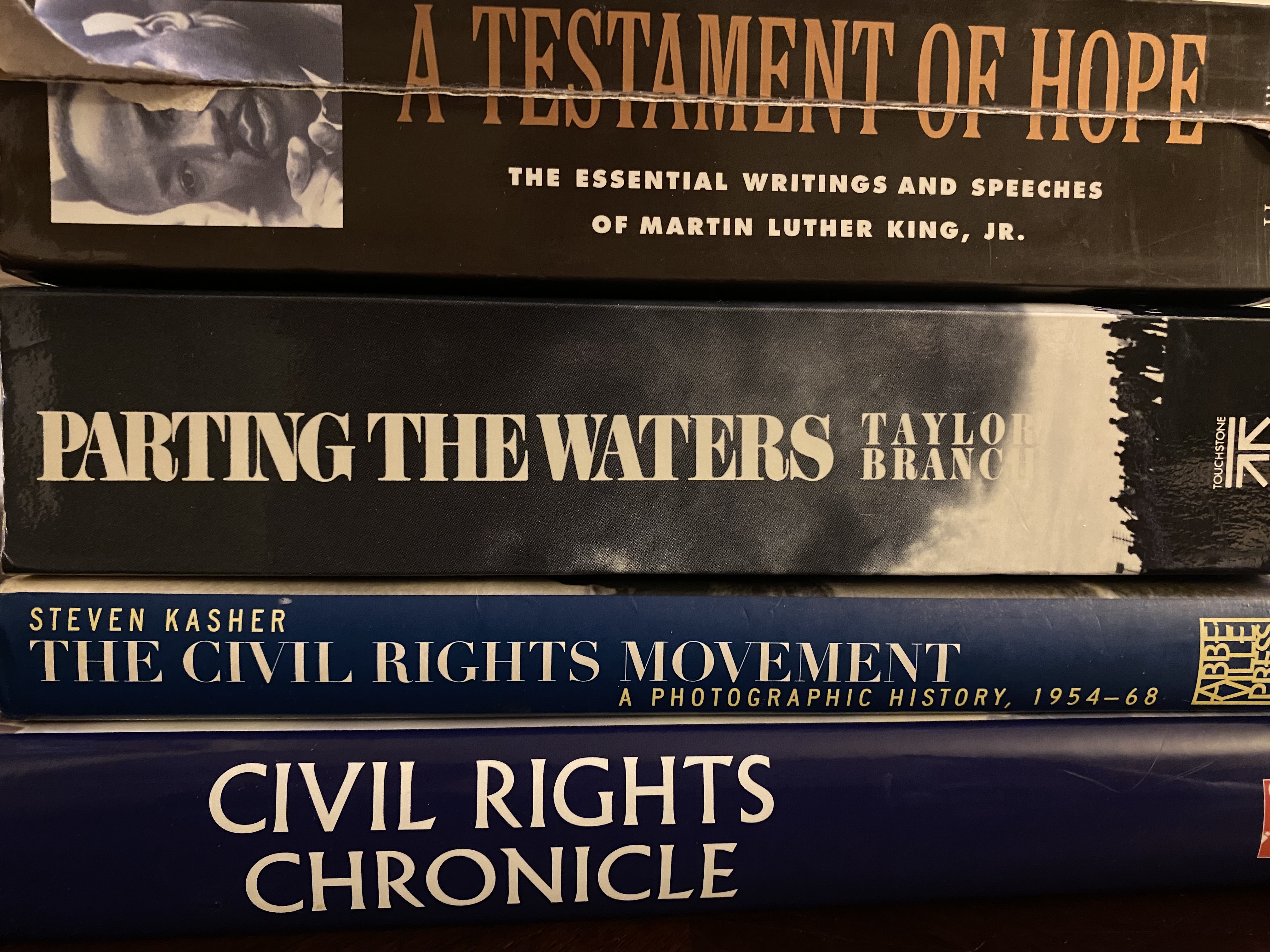
When I first started writing these reflections, one motivation was my frustration with how I saw Dr. Martin Luther King, Jr. Day being observed (or rather, not observed) and trying to find a way to bring more gravity to the day in my own life. Now, twenty years later, I am still writing each year to ground myself in the values of the Civil Rights Movement with the resolve to continue to contribute to the ongoing work today. And I am less concerned about how individuals mark Martin Luther King, Jr. Day and more concerned with how we honor the legacy of the Civil Rights Movement every day.
I sometimes use a training activity to introduce the concept of implicit bias using bumper stickers. I show rotating images of different kinds of bumper stickers – from political to religious to silly. I ask people to pay attention to their reactions as the bumper stickers scroll – any feelings, thoughts, images that come to mind. We debrief the activity by talking about the associations and assumptions we make, which usually generates good discussion.
One of the bumper stickers I often include is an image of Dr. King with his hands up, being arrested. Next to the image are the words “Hands Up, Don’t Shoot. Black Lives Matter.” I’ve done this activity with folks in different parts of Colorado and the rest of the country. And often there is one person in the group that will mention that particular bumper sticker as one that stood out to them because they were offended by the use of Dr. King’s image with Black Lives Matter. Often the refrain is something along the lines of “that’s not what King stood for.” My experience has been that the person saying this is always white. While earnest in their reaction, I’ve been struck by the pattern. And the danger in what their reaction belies.
It is a danger we see every year at this time as people mark Dr. King’s birthday with quotes and platitudes devoid of the original context and molded to fit each individual’s worldview. The idea that King’s legacy is not inextricably linked to the current day fight to dismantle systemic racism feels outrageous, and yet, there it is. As we get further away from King’s life, we must protect against the ways his legacy is being perversely used to maintain the status quo.
Dr. King is not a mirror where we can see whatever version of him we want reflected back. His legacy is not a cloak we can put on as comfort against the painful realities of our current struggle. We cannot look away from that pain and struggle.
We cannot forget that when Dr. King was alive, and at the time of his murder, he was not universally loved. During Dr. King’s time, a majority of people in the United States had a negative opinion of him and did not believe he was helping the Civil Rights cause. And after his death, a third of people in the U.S. even said he brought his assassination on himself. And, of course, The Civil Rights Movement was a protest movement, not universally supported or understood.
Contrast that with the prolific use of his quotes and imagery and references to him today, not just on this holiday, but throughout the year, most regularly as a political tool and weapon. As time moves on, King’s legacy is often presented as if he spoke, shared a dream and everyone collectively said “Oh yeah, definitely, let’s do that.”
Some of this is cynical political machinations; for others it is a sincerely held, misinformed understanding of King and the Civil Rights Movement (often informed by the cynical political machinations). And it matters, especially in our current reality.
We are living in a time where the false flag of Critical Race Theory is being used to stop the teaching of our nation’s history and promote not only an adulterated version of Dr. King but of the country’s history of systemic racism. We are living during a time when voting rights are being attacked and dismantled, threatening our democracy. We are living in a pandemic that continues to lay bare the systemic inequities of racism and classism. We are living in a society where the majority of our youth attend segregated schools and opportunity is predicted by zip code. All of these are part of the mechanisms to maintain the status quo of systemic racism.
I hope that this Dr. Martin Luther King, Jr. Day, we will root ourselves in Dr. King’s legacy of disrupting the status quo and reject the current distorted use of his life’s work.
In 2003 I wrote, “MLK Jr. was a pretty prolific writer and orator during his short life and he has much to say that is relevant to the world we face today: issues not just of racism but equity, socio-economics and war. Unfortunately, years after King’s assassination, concerns of civil liberties and freedom, racism and prejudice, fear and strife are very relevant in our lives.” Well, it’s now been fifty-three years since his assassination and the sentiment remains true. I hope that we’ll go back to the source- not just quotes and memes- but King’s speeches, sermons and writings.
In them, we will find not a mirror but a clear picture of a movement for equity and civil rights that continues its fight today.
One final note:
Speaking of the fight today, Dr. King’s family has called on us to take action on voting rights, urging people to “call on Congress to enact changes to elections law nationwide, rather than honoring Dr. King with celebrations on the federal holiday that marks his birthday.” Contact your United States Senators and encourage them to support The Freedom to Vote: John R. Lewis Act when it comes up for a vote. You can learn more about how to advocate for this important right:
https://action.aclu.org/send-message/congress-protect-our-voting-right
Engage: Martin Luther King, Jr. Day Reflection 2021
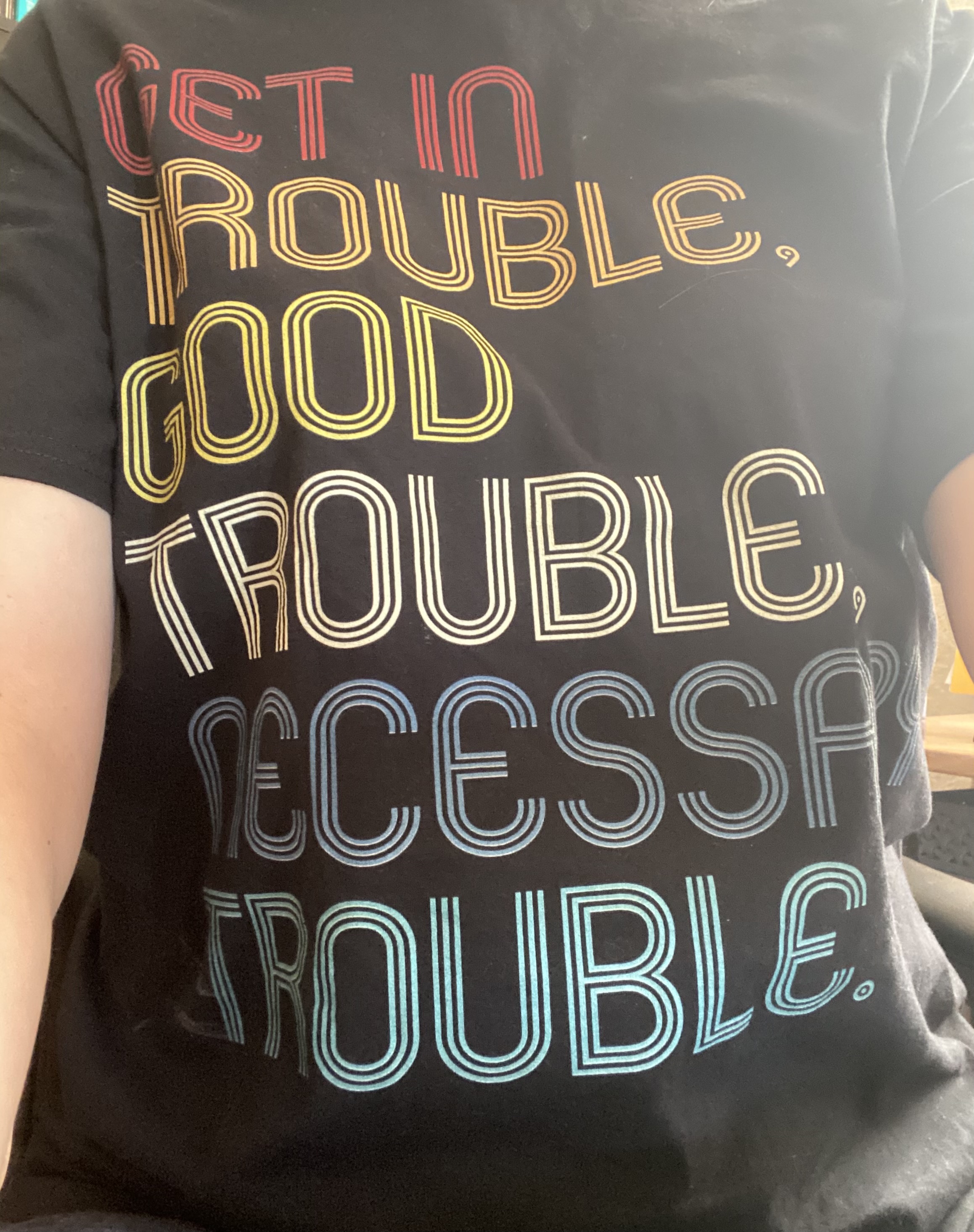
The other day, I was talking to my friend Esther about the strange feeling of living through history. I know that technically everything becomes history and yet our current time is one that we know will be written about in history books. And I know that I personally am having a hard time processing all that it means amidst the mundane aspects of life – homework and dishes and grocery shopping – that still require attention.
We are all carrying this heaviness of simply living in the midst of all that has transpired just in the last year: a President impeached (twice), a global pandemic, the renewed reckoning of our country’s racial injustice and terror after the murder of George Floyd and far too many more, and now we are faced with the fragility of democracy with an attempted insurrection and heightened fear as we ready for the inauguration. I confess I do not know how to make sense of it all.
And so I’ve been trying to anchor myself in the things that feel more tangible; in places where I feel some sense of control. I reread my reflections since 2016 and found themes around how I’ve tried to make meaning of our current time and engage in action in the past four years. And then, about a week ago, a friend on Facebook, Nimita, shared this:

And it helped crystallize for me one of those tangible anchors and choices I can make right now. I can choose to actively engage with other white folks to address our racism, rather than stay comfortable in my “bubble.” So this year’s post is for us white people, specifically. I am focusing on guiding reminders to keep me focused on dismantling racism in myself, in others and in our institutions.
Passive pronouncements are just that… passive
We know (and were reminded this week) that social media is a powerful tool. It also fools us into thinking we’re “doing” more than we are. Passive pronouncements of our values, like “If you support racism, we’re not friends,” are still passive. And there is nothing more passive than telling someone “unfriend me.” That’s not even doing the work of actively hitting the unfriend button. And it certainly doesn’t do anything tangible to address racism. But it may delude us into thinking we’ve “taken a stand.” The same is true offline when we simply stop talking or engaging with others. Or when we join in calling out other white people and taking comfort in the fact that “we’d never do anything like that” or “we are appalled by that behavior.”
Motivation matters
Especially in the last four years, I have seen and heard, as well as thought to myself, countless versions of “I told them the facts. I told them they’re racist and they didn’t change. I’m done.” When my motivation is to change someone else, I almost always end up dissatisfied with the results. I have set myself up, because -simply put- I don’t have control over others.
What I can do is offer an alternative, another perspective. If my motivation is to engage, my energy is different: I ask questions and seek to understand (not agree, but understand). I can recognize and engage with the cognitive dissonance and the resistance in others, when I remember that I’ve experienced them myself.
Seeing myself
White people, we are really good at playing the “I’m a good white person” game and trying to distance ourselves from other white people. But we must not be fooled; this is just another version of “rugged individualism” that maintains white supremacy. Separating myself from other white people serves my ego, not the cause.
When I find myself in that space, I will try to see myself in the other person and ask myself: How am I like them? When have I felt that way? In many ways, dismantling racism is an attempt to dismantle our own foundation. The desire to protect oneself, to take a defensive posture is understandable. I didn’t get to any place in my journey on my own; I should not expect others to do so either.
Reframe accountability
As a society we don’t seem to know how to hold people accountable outside of a purely punitive context, without opportunity for repair or change. I think that’s why so many of our reactions are some version of “you’ve done bad, I banish you.” I am trying to reframe accountability and find ways to hold people accountable while holding on to their humanity as well as my own. That means being clear about the impact of their words or actions without denigrating them as people. It means requiring taking responsibility for their impact while leaving opportunity to repair. It means remembering that “we are all more than the worst thing we’ve done.” (Bryan Stevenson).
Expect failure
If my fortitude is predicated on success, I will not persist.
In addition to reframing accountability, I must also look at what it means to hold myself accountable – to continue to make moral choices regardless of the immediate outcome, to persist through risk and failure. Sixty years after the Civil Rights Movement, I think Dr. King’s legacy is often condensed into his successes. And yet the reality is that there was never any certainty that the movement would be successful. For me, Dr. King’s legacy is in the continued effort, despite failures, despite risk.
When I was in graduate school, my mentor and advisor, Mari Strombon Johnson once told me – referring to equity and inclusion training- “one person has to hear something 32 times before it will stick.” Which means that there has to be 32 “messengers” willing to deliver the message to that one person. Thirty-two wasn’t a scientific number, but rather a reminder that we had to be in it for the long haul. Her point was that if you’re the 32nd messenger, the payoff is immediate, with the recipient responding with some version of “I get it” and it is easy to feel successful. More often than not, we will be messengers #1 – 31, delivering the message, getting resistance, offering a different way and trusting someone else will continue after us. There is no “payoff,” only hope that it will come. This also helps to keep me from slipping into the dreaded posture of “white savior” and a misplaced and dangerous belief that I alone must (and can) take it all on.
Intentional engagement
For many of us, social media algorithms create echo chambers that manipulate us into thinking that everyone is already with us. Add in the bubble creator of a different kind- COVID- and we may be even more isolated. In these cases, rather than think “well thank goodness I don’t have those friends,” we may need to be more intentional and take additional effort to engage.
I also have taken note and understand the critique by some BIPOC (Black, Indigenous, People of Color) that white people are wasting our time with proverbial “racist uncles” and should focus instead on systemic change. I think it’s a both/and: we can engage with individuals one-on-one and choose to focus on systemic changes where we can have influence. We can address systems through our places of work, schools, religious institutions and organizations where we volunteer. There is no limit to the places where we can ask hard questions, challenge and hold leaders accountable, take risks, and address racial inequities. In many cases, a big part of that work is engaging with other white people. We do not need to compartmentalize, nor should we. However, we can and should be intentional about where we can have the most impact. None of us can do it all. That doesn’t mean we shouldn’t do something.
I’m not naive. I am not suggesting that it is as simple as talking to someone. There are real challenges and a strong hold of disinformation, stridency and division. AND I also know that if as white people we turn away and simply wash our hands of other white people, while patting ourselves on the back in our circle of other “anti-racists,” we are most certainly not engaging in anti-racism.
Dr. Martin Luther King Jr. Day is one day. For me, it is a moment for reflection and recommitment. This year it is a day to pause and consider the places where I falter. And remind and recommit myself to the ongoing work that remains, every single day. I hope you will join me.
Inspiration and Inadequacy: A Reflection on John Lewis (for MLK DAY 2020)
The first time I remember learning about the Civil Rights Movement and the people involved, I was in middle school. I had to do a book report on a biography and I chose Coretta Scott King. I was what many would have described as a voracious reader and remember middle school as a time of realization for me about a number of societal issues- historical and modern day. I began developing my personal values and social justice convictions through those stories and books.
However, it was when I entered college at Texas A&M University in the early 1990s, that I first learned about Civil Rights leader, John Lewis. I was particularly taken because he was a teenager when he got involved in the Civil Rights Movement. And when he participated in the Freedom Rides and lead the Student Nonviolent Coordinating Committee, he was the same age as I was in college.
I was enthralled with his bravery and drawn to his commitment, while embarrassed by my relative lack of “doing” at the same age. He ignited in me a dual sense of inspiration and inadequacy, that I still carry today. He was not just a historical figure; at that time, he was still involved in the fight as a Congressperson more than thirty years later. It was even more compelling to me that he had not put his marching shoes away and continued to get into what he called “good trouble.” He continued to march and fight for what he believed.
I wasn’t someone who put Tiger Beat pictures on my walls or obsessed about the latest teen heartthrob. John Lewis was the closest thing for me of a “celebrity crush.” More accurately, I described him as my hero. And I still do today.
Fast forward to the early 2000s and I was working in education at the ADL. I found out that John Lewis would be speaking at the ADL’s National Leadership Meeting in Washington, DC – an event that education staff did not typically attend. I got permission to hear him speak at an ADL event, if I paid my own way, so I did. And after his speech, I snuck out and ran down the hallway of the hotel to shake his hand and get a picture with him. It was my “fangirl” moment and one of the best memories of my life.
However, I think it is important to reflect a bit more. This shouldn’t be understood just a story of my brush with my favorite “celebrity.” When I first learned about John Lewis, I had the feeling of connection and awe – the realization of what someone so young can accomplish and I think it was natural for me to try to see myself in him. Beyond that, I was taken by the other young people who were at the heart of the Civil Rights Movement. I tried to imagine myself in that space and time. Would I have had the courage that they did? What would I have done in the face of hatred, vitriol and injustice?
Many people look at historical events and imagine themselves as among the heroes. They assume that they would have been on the “right side” of history. The reality is that there were far fewer people engaged in the Civil Rights Movement, or any other resistance movement, than those who either opposed it actively or were complacent.
And that is what I had to come to terms with. I was drawn to my hero because I wanted to see myself in him. I felt motivated by his story because I felt an affinity with his youth. I wanted so much to connect with the cause and relate to the people being oppressed; to relate to my hero. Yet, there was something that I had to reconcile.
My race. My race as group membership. My race as a key element of my experience in the world.
The reality is that my people – white people – are the oppressors in that history. I know that there were white folks who fought alongside black people during the Civil Rights Movement, but to only see myself in them and not in all the people who fought to maintain the status quo through laws, resistance, violence and complacency is dishonest and disingenuous. If I truly wanted to emulate the values of my hero, I first had to acknowledge who I am.
And that has been my journey. To reconcile the ways that I benefit and reinforce white privilege and white supremacy, despite my beliefs and values is ongoing and hard.
And it is mandatory, if I want to honor John Lewis and his legacy of good trouble.
So, the reality is that I don’t know what I would have done in the Civil Rights Movement. It is much easier to cast myself as a character in the past – through a lens of history that makes everything and everyone more neatly defined – than to understand myself as a character in the present- where the view is much murkier.
Mass incarceration of black and brown bodies. Police brutality. Detention camps and children in cages at the border. Racism and xenophobia as foundations to our current immigration policies. Looming prospect of war with Iran. Islamophobia as a foreign policy. Presidential impeachment. Anti-semitic attacks and hate crimes. The loss of protections for LGBTQ+ youth and the rolling back of progress we thought was institutionalized. The ongoing natural disasters in Puerto Rico magnified by the racist policies undergirding US treatment of its citizens. The murder rate of trans women, especially Black trans women.
These and other injustices are all happening now. And that dual sense of inspiration and inadequacy are still with me today. Every day, I don’t know that I am doing enough. And I often allow myself to get stuck in feelings of helplessness. I am not at all sure that the lens of history will view me favorably. That’s the honest truth. And it is also true that I feel compelled to continue to try.
I remain inspired by John Lewis’ life and legacy. I said that John Lewis is a hero. He is. But hero as a noun feels too passive a description. For John Lewis is really defined by doing, by getting into “good trouble.” John Lewis isn’t just a hero, he heroes (active, present tense). He has heroed every day for over 60 years.
And he is a model for how each of us can choose actions to “hero” everyday, too. I endeavor to engage in actions each day that align with my highest ideals and cause “good trouble” – rooted in my identities. with my flaws. with conviction.
I don’t always get it right. I fail a lot.
And with that mixture of inspiration and inadequacy, I promise to try again tomorrow.

Stuck: Martin Luther King Day Reflection 2019
Exhausted. Angry. Depressed. Resigned. Frustrated. Cynical.
I have felt all of these over the last year. I know you have too.
In the face of the explicit and constant hate, it can feel overwhelming and demoralizing. The harm and deaths at the hands of hate are devastating. A lot of the rhetoric and energy over the past few months has focused on combatting hate. It is important and compelling.
And yet, as we approach Martin Luther King Jr. Day, the message most clear in my heart is this: the absence of hate does not equal the absence of racism. Or sexism. Or discrimination against trans people. Or the end of oppression for any marginalized group.
My concern is that a single focus on hate lulls us into ignoring the persistence of the system. If we truly ended hate, of course it would be positive. All of us would rejoice in a world that would surely see less vitriol and less violence. We would see the end of the singular extreme acts which many people have come to understand as racism. But we would not see the end of racism. Because hate and hate incidents are not the same as systemic oppression.
Hate did not create systemic racism. Hate did not create persistent educational inequity. Hate did not create the school to prison pipeline. Hate did not create the gender gap. Despite the horrible rhetoric we hear coming from the President, hate does not inform the country’s immigration policy which persistently marginalizes and injures people of color[i]. Hate does not maintain inequities in health care or real estate.
Ending hate is too low a bar.
And I fear that our attention on “hate” serves as a distraction. It deludes us into believing that we are fighting the “good fight” without addressing the “good people” who maintain the system. And white folks, the singular focus on hate serves us.
The idea that hate is the ultimate motivator of racism is cultivated to maintain the status quo. By framing it this way, most white people feel exempt from any personal responsibility for racist behavior (“I don’t hate people of color”) while simultaneously feeling righteous in condemning individual examples of hate (“That rhetoric was abhorrent! I would never use that language”).
It’s a cycle that replicates itself and distracts from the racism operating every day. In other words, the stubborn insistence in the belief that racism is an individual act fueled by hate serves to maintain and feed systemic racism in our society.
If you’re starting to feel defensive or angry, please stay with me. I want to remind you of an important point I have written about in previous years that bears repeating: You do not need to be a person of ill will to perpetuate racism. The dichotomy of racist (bad person) and non-racist (good person) does not truly exist. You can be a good person and engage in racist behavior.
Robin DiAngelo writes “The most effective adaptation of racism over time is the idea that racism is conscious bias held by mean people. This ‘good/bad binary,’ positing a world of evil racists and compassionate non-racists, is itself a racist construct, eliding systemic injustice and imbuing racism with such shattering moral meaning that white people, especially progressives, cannot bear to face their collusion in it.[ii]” So, if we stayed locked in the belief that acknowledging our racist thoughts or behavior makes us bad people, we will be perpetually stuck.
And we will not see any meaningful change in our society. We will not see King’s dream fulfilled. We will not see the arc of the universe bend towards justice. We will not see the fruition of any of the other sentiments expressed around MLK Day each year, sentiments that become mere platitudes absent true reflection and action.
And what is that action? The compelling antidote to hate we’re told is love. I don’t dismiss the power of love. But I do believe that we must interrogate what we mean by “love.” What is love? Is it simply an idea? A sentiment? What kind of love?
King himself distinguishes between types of love: “eros” – romantic love, “philia” – love for personal friends and “agape”- understanding, creative, redemptive good will toward all people[iii]. I gravitate towards Cornel West’s belief that “justice is what love looks like in public.” These manifestations of love – Agape. Justice. – assume action. They are verbs, not nouns.
And that action includes turning inward. This love challenges our perceptions of self and engages in the hard work of recognizing our part in perpetuating racism.
The kind of love worthy of fulfilling the promise of MLK’s dream is love which seeks to be much more than an antidote to hate, but instead, a force against oppression.
Endnotes:
[i] https://scholarship.law.berkeley.edu/cgi/viewcontent.cgi?article=1264&context=blrlj
[ii] https://www.newyorker.com/books/page-turner/a-sociologist-examines-the-white-fragility-that-prevents-white-americans-from-confronting-racism?fbclid=IwAR2kM9lTSnNhCkNIFzPxWksaJeKdUaZucQtRkKLjxi9PyTSju4aOnaovjBY
[iii] “A Christmas Sermon on Peace,” Martin Luther King, Jr, 1967
Resolve: Martin Luther King Day Reflection 2018
I’ll be honest; I don’t know what to write. It’s Sunday morning and I’m still drafting a reflection. Usually I’ve been writing down notes for the past week and have it written by Friday. This year, I feel stuck and sad and unsure and overwhelmed.
I am sad for many reasons. Most on my mind is the death of a wonderful person, Daryl Miller, who passed this week. Damn cancer. I had the pleasure of getting to know and work with him through WPC and The Matrix Center at UCCS. He was an amazing, sweet, kind person and he was also such a compassionate, thoughtful and committed “drum major” for justice (to quote King). Truly. I don’t describe him that way lightly. This is not just a personal loss which brings waves of emotions, chief among them grief and regret; his was a loss to the world which feels even more devastating in our current times.
We need more Daryls.
Part of me just wants to end with that.
Because it’s true. And because I am unsure what to write that is useful and adds value. I am increasingly weary of platitudes and earnest, but ultimately useless, laments.
I am having trouble striking the right tone- each year I work hard to be contemplative and encouraging without coming off as self-righteous or too strident. Partly this is strategic- people are more likely to read and be open to the content that way- however, if I’m honest it’s also because part of me wants to be liked and I think that if I come off too strong, I’ll turn people off. (This comes from a ton of gender messaging about how women/femme folks are supposed to behave. Plenty to analyze there, but I’ll save that for another time.)
At any rate, part of my trouble writing is that this year I don’t feel particularly conciliatory. So rather than write from a place of suggestions and self-reflection, I’m just going to pretend like you asked and tell you what I really think.
This past year we had plenty of stark examples of how discrimination and oppression operate as systems in our country. From the battle over who should be valorized and set as our heroes in bronze or stone (and what history we choose to tell) to the high-profile demise of powerful men engaged in sexual harassment and assault to the daily explicit examples of racism, we are surrounded.
While these are hard to ignore, they make it easier to ignore our own complicity. Make it easier to feel smug in our horror at what is happening and to ignore our own behavior.
By way of example, after allegations began to make headlines and it became clear that these were not isolated instances, and all could not be blamed on Harvey Weinstein, most men I know shook their heads and decried the behavior. And that was it. That is not enough.
Men, you’ve ignored a sexist comment, you’ve laughed at a crude joke about women even when it made you feel uncomfortable, you were surprised when you encountered a woman in charge, you’ve ignored when a mediocre man was given a promotion and have acted out of an internalized belief that men are superior.
I know this because as I white person I have done the same around race. Now it’s been a long time since I’ve let a racist joke go by, true, but that’s a pretty low bar folks. Plus, the explicit is often actually easier to address and feel self-righteous about. It’s all the other ways that I participate in the system that is the more insidious problem. Racism doesn’t happen because of individual racists. Racism happens because of a system made up of individuals who are complicit. As a white person, if I don’t understand my role in racism and don’t tangibly embrace racism as MY problem then it doesn’t matter how much head shaking and outrage-professing I engage in.
That goes for you too- in all the ways that you ignore discrimination and oppression because they don’t target your identity.
If all that happens is statues come down and we don’t talk about what they truly mean in terms of not just our history but our present, then nothing has changed beyond the symbolic.
If all that happens is men lose their jobs and we shake our heads, then the system doesn’t change.
If all that happens is that we read a list of names of people murdered, targeted because of bias towards their trans identity, but don’t seek to change the systemic reasons why transgender people are more vulnerable to violence, then nothing has changed.
If all that happens is we share disgust with the racist policies enacted and maintained by our government and do not demand change through all venues available as a democracy, then the status quo is maintained.
If all that happens is that we share some Martin Luther King, Jr. quotes out of context and don’t actually seek to dismantle racism in its current form, then it was just a holiday.
It’s time to RESOLVE. Resolve to DO something. Resolve to TAKE actions. Some of you already have. It doesn’t hurt to do it again.
So, resolve. Today, every damn day, resolve.
White folks, resolve to make racism your issue.
Men and male-identified, resolve to makes sexism your issue.
Middle class and upper middle class, resolve to make classism your issue.
Cisgender folks, resolve to make transphobia your issue.
Straight folks, resolve to make heterosexism your issue.
Able-bodied, resolve to make disability rights your issue.
On and on.
RESOLVE.

Promises: Martin Luther King Day Reflection 2017
For years, as I’ve been engaged in anti-bias and social justice work, I have said that my goal was to work myself out of a job. Over time I have adjusted that goal. While I would love for that to be the case, it is increasingly clear that for all of us concerned with civil rights and justice, this is a lifetime job of maintenance. Like laundry, it is a never-ending cycle.
The cycle of fighting for justice. Ours is the maintenance of holding our country and its people to its ideals–a constant vigilant expectation of our inalienable rights and holding all of us accountable when we falter. As President Obama said in his farewell speech, “these rights, while self-evident, have never been self-executing; that “We, the People,” through the instrument of our democracy, can form a more perfect union.”
Sometimes this maintenance may feel more routine and easier when accomplishments are made. And other times, the washing machine breaks down. The weeds threaten to overrun. The foundation cracks. The instrument of our democracy falters. And the maintenance becomes a much harder job.
It’s an imperfect analogy I know, but it helps me put our current climate into perspective. I have a different outlook and resolve now that I am committed to the long-term upkeep of our core values, the values on which King built his dream for this country, the foundation of values from which our country is still aspiring to build.
I do believe that the arc of justice King famously spoke about does ultimately bend towards justice. Yet, I have failed to truly comprehend two important truths: 1) the arc doesn’t bend on its own; people must mold and direct it and 2) it is not a straight path; sometimes the arc doubles back on itself again before moving forward.
The foundation has certainly cracked. And it is a time where many people have either renewed their commitment or have come to the work of maintenance anew. I’ve decided that this reflection will not be a recap all my concerns or an enumeration of how people’s humanity, rights and even their lives, are threatened. There are many articles written by people far more astute than me about the specific ways to address, resist and rally: against racism to homophobia, Islamophobia to anti-Semitism, transphobia to misogyny, classism to ableism. I am working to learn, grow and remain engaged in that work and hope that anyone reading this is engaged as well. (Here are two resources that I have found meaningful: Women’s March Platform and Indivisible)
But make no mistake, I am angry y’all!
And that anger started long before November 8th and has only grown since. (Apologies to my family because sometimes that anger has come out sideways.) Because I know that anger needs to be focused to be effective. Leading up to this Martin Luther King Jr. Day, I have been reflecting deeply on the maintenance of my own foundation of core values. And I have been thinking a lot about my identity as a parent and how to insure that my children’s foundation of values are strong as well.
I’ve been thinking about the promises I want to make to myself; promises written from me to my two girls (“Little One” and “Bigger One”). And perhaps they will resonate for you and spark the promises you want renew for yourself this Martin Luther King Day.
My Promises
My little loves, I promise to continue to strengthen my foundation of core beliefs and family values related to social justice and challenging discrimination both for myself and to impart to you.
Overt bias should not serve as cover
The vitriol and overt bias; the rise of extremists and hate groups is incredibly concerning and we must always denounce and work to oppose those forces. And I fear this opposition will become a position of comfort. It’s so easy to denounce hate and feel moral superiority because we would “never say or do those things.” We must avoid the temptation to use blatant examples of racism (and other isms) to ignore our own bias and complicity in a system that is designed to benefit some groups over others.
If you’re not willing to own groupness, you are likely to show up like a group – Jamie Washington, Social Justice Training Institute, San Diego, 2016
Which is why I strive for both of you to understand (and for me to continue to grapple with) that you are not just singular individuals; you belong to group identities. Before anyone gets to know you, you are treated certain ways because of your skin color, gender, gender identity, socioeconomic status, age, perceived religion and more. And through your group identity, you receive benefits through no actual work of your own; and in others, you are disadvantaged, also through no fault of your own. Bigger One, you experienced the sting of this when you were the only girl on the basketball team and we had to explain sexism at the age of six. And much like the boys on that team, groupness is much harder to see when you are the beneficiary.
As you grow, I know that this may be hard for you to accept–that you are not just an individual. I know that I sometimes fall into a pattern of ignoring this in my own life. Yet, before anyone gets to know me, people see me first as a white, middle aged (how’d that happen?), middle class, straight, PTA/soccer mom. And despite the fact that I might think “that’s not who I am. People don’t know me,” if I am equally honest I also know: 1) I don’t want to be lumped with others because of my own stereotypes about those white-middle-aged-middle-class, straight, PTA/soccer moms and 2) I want to be seen as “better” than those stereotypes and 3) that most of those identities (and the combination of them) almost always bring advantages, access and generally positive treatment. And all of that trickles down to you, my loves.
We may not want it, we didn’t choose it, but to pretend that group identity doesn’t matter is to ignore the reality of our society. We may not want it, we didn’t choose it, but to shrug it off is to continue to perpetuate inequity. And so I promise to spend more time wrestling with groupness and teaching you about yours.
I hope when you see me, you see my brown skin, because it is beautiful – Shruti Desai, Facebook Post Series on Recentering Non-dominant cultural values, Day 11: Brown
At the same time that we recognize that our world operates on the group level, I also want you to see people in their full selves– to see them as individuals. Because the reality of groupness is that some of them are seen and others are made invisible, especially around race. I know it may seem confusing to recognize both the power of group and the importance of individuals and that’s part of my promise to you: to help you grapple with the “both/and” and to recognize that life is complicated and nuanced.
One time, I was talking with one of Daddy’s friends who identifies as Black; we were talking about how she is one of only three Black women in her office and they are often called by each other’s names by white people. We were joking about it (humor being a coping mechanism) but then she ended by saying “I just wish people would see me.” The mix of pain and resignation in her voice stayed with me. And that, my loves, is one of greatest failures of our society–that Daddy’s friend has to wish to be seen or my friend Shruti (quoted above) has to remind people to see her brown skin and to know that it is beautiful.
From beauty standards to societal “norms,” your Daddy and I are working against a society that will give you both tons of messages that your skin color or class status makes you worthy, alongside messages that your friends of color are not as worthy or that your friends who are poor are not as worthy (and many other “different” identities are not as worthy). Those are lies. And it is a fight every day to provide a different truth, to reject internalizing the dominant messages. And that is why we try to be so intentional in providing you with alternative images and stories. Sometimes we fail to notice the norms. Sometimes you resist our efforts. I promise to keep trying.
A compliment to someone else takes nothing away from you. – Mommy
I know I say this phrase often enough that Bigger One rolls her eyes (Little One will soon follow, I’m sure). It’s usually in response to a rise of jealousy because your sister is getting attention or praise. But the message applies to a much larger truth and a much larger issue.
Perhaps the most important promise I can make is to teach you both this lesson:
You are the center of my and Daddy’s world. You are not the center of the world. You are the most special to me and Dad. You are not more special than any other child. You are deserving and we want the world for you. You are not more deserving than anyone else.
It may be hard to hear. I know that there are other parents who will be appalled by this message. I know that this message is counter to society’s messages. However, if I have the hope of raising you to be kind, grateful, empathetic and giving; to feel the weight of responsibility to fight for justice, than it’s a message you must learn. I truly believe that we stand in this place of “living history” because we have lived in a society that has sold white people, men and Christians the lie that they are entitled to more, inevitably and without question.
Commonality is not the basis for respect – also Mommy
The idea of finding similarities is often the language used in superficial diversity work (i.e. “we all bleed red”). I know that I have fallen into this trap many times. Don’t get me wrong, finding things in common with someone who seems very different from you can be beautiful. And commonality should not be the requirement for offering kindness, understanding or empathy. All people are entitled to be treated with dignity regardless of whether you have a single thing in common or not. You deserve to be treated with dignity whether someone has anything in common with you or not. Little One and Bigger One, I expect you to treat everyone with dignity. My final promise is to live this truth with you every day.
And those are my promises. And in this time when the washing machine has broken down and the foundation is showing its cracks, I’m wishing everyone the strength, courage and dignity to continue the important work of maintaining our ideals, this day and every day.

Words (a poem): Martin Luther King Jr. Day Reflection 2016
Every year I sit down to write my reflection before Martin Luther King, Jr Day. Usually my thoughts begin to form weeks ahead of time, swirling in my head as I process what I feel and need to say. This year, I struggled.
The ugliness of racism, which is always there, feels more overwhelming to me this year. There is so much to say and yet, if I’m honest a part of me thinks “what’s the point?” and another part feels that there are more expressions, explanations, indictments, rebuttals and real-time reactions than ever before which say so eloquently what I wish to express. I am stuck with wondering “what else do I have to add?”
I thought about just making a list of links to the wonderful pieces that are out there already; works that have moved and challenged me around race and racism this year. And then I started to think about the purpose of blogs, essays, prose and how we use language and the refrain “words” kept coming up for me. What is the purpose of a word? So, this year my reflection comes in a different form- a poem of sorts- as I try to untangle within myself my own motivations for these reflections and to understand a society damaged by racism, generally, and anti-blackness, specifically .
Words are not adequate
Words are too small
(11 pt font)
Words cannot capture
-are never enough to encompass the feelings, emotions and impact
(racism)
Yet words are powerful
Words have meaning
Words are both
weapon
and
balm
Words reveal dreams
(told by a King)
and expose dreams unfulfilled
(“a dream that one day this nation will rise up, to live out the true meaning of its creed”)
Words empower movements
(#blacklivesmatter)
and demagogues
(#trump4president)
They tell stories
(I wish I never knew)
of names
(I wish I never heard)
(because then they’d be living their stories, present tense, not exist as names spoken, past tense)
like Tamir Rice, Michael Brown, Sandra Bland
(you know the list keeps going and going, right?)
Words assign
identity
(black boy) (“whose size made him look much older”)
culpability
(“and who had been warned his pellet gun might get him into trouble that day”)
blame
(“it was reasonable to believe the officer who killed the boy believed he was a threat”)
excuse
(“a perfect storm of human error”)
Words distract
(why aren’t we talking about black on black crime?)
Words describe
the mundane
(playing in the park, walking down the street, driving a car)
the profane
(shot in less than 2 seconds, left in the street for 4 hours, found dead in her cell)
the obscene
(every comment section , every news article)
They wrap around each other twisting, obscuring, knotting
(truth and lie) (opinion and fact)
Words maintain
(status quo) (white supremacy)
They indict
exonerate
justify
(race) (constructed)
They defend and dismiss
(but he’s a good person)
They explain
(good and bad are not relevant) (systemic racism)
Words express
pain
and anger
and love
and frustration
and joy
and
Words cannot
explain the unfathomable
make us forget
bring them back
Words are inadequate
Words are powerful
(words are all I have today)
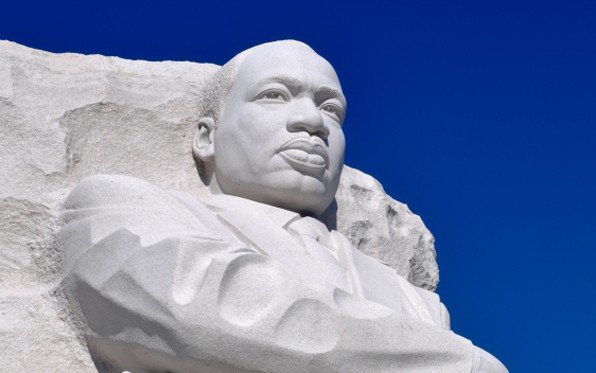
Stories: Martin Luther King Day Reflection 2015
This year’s reflection is about stories.
The stories we are told, the stories we aren’t; the stories we believe and the stories we dismiss; the stories we tell ourselves, the stories we tell children; the stories that are myth and the stories that misunderstood.
Stories we tell ourselves.
I think we tell ourselves stories all the time. Narratives we weave to explain and understand the world around us, especially other people.
Like this.
Imagine you’re sitting at a stop light and you don’t realize that the light has turned green. The person in the car behind you honks to let you know the light has turned green. You get defensive; maybe say aloud “Have some patience!” (Or perhaps something more colorful).
Another day you’re at a light and the light turns green and the car in front of you doesn’t go immediately. Do you “have some patience!”? Or, like me, do you get frustrated and perhaps tell yourself a story about the incompetence of the person in front of you. “Not paying attention- too busy texting to drive.” Or, if you’re honest, maybe your story is a little more specific: “those teens are always texting”; “that old lady needs to get off the road”; “those people need to learn to drive”…
We tell ourselves stories all the time, usually without thinking about it. And I think the stories often reveal our biases (explicit and implicit) and certainly our assumptions. Sometimes it’s just a story or a fleeting thought known only to ourselves. Sometimes we catch ourselves as the story forms – recognize the bias – and rewrite it in the moment. And sometime that story has larger implications-
an applicant not hired, a student suspended, a gun fired.
Those are the stories I’m thinking about today.
Stories that are representative
We celebrate and honor Martin Luther King, Jr. as a singular, extraordinary man. But we also honor the people and the movement, the struggle and the sacrifice he represents. He has become more than just his own story. This past year, we have come to know the stories (or rather the tragic end of the stories) of Mike Brown, Eric Garner and Tamir Rice. They are both singular and representative of the anger, frustration, fear and anguish of an unjust system. These men became more than just their death. And their stories must be told- no shouted- because there are so many similar stories never even whispered.
Stories that are “color blind”
But there is one story about race we hear all the time. I believe that one of the most destructive race stories told in the United States is the ideology of being colorblind. This myth is often told through the misinterpretation (at best) of King’s words: “I have a dream that my four little children will one day live in a nation where they will not be judged by the color of their skin but by the content of their character.” Not judging someone by their race is not the same as not seeing their race. Colorblindness erases an important part of many people’s identity. And ignores reality. And is paralyzing.
If we believe the mythology of colorblindness, then we cannot actually talk about race even in the most basic sense. And we certainly cannot address racism. My eyes are brown; my hair color changes depending on the dye I use; my skin is white. If you don’t see those things, you don’t see me. Ignoring people’s identities is not progress. Progress is seeing a person for their full self and treating them with respect and dignity. Progress is recognizing the ways that racism is present in our systems and addressing them. Progress is telling the story of racism in this country with nuance and texture and truth.
Stories that are “good” or “bad”
Stories are often presented as dichotomy, either someone is a good person OR they are bad. This is especially true in narratives about racism. For example, if we name our concerns about racism in law enforcement, then we are interpreted as saying that all police officers are “bad.” The obligatory counter story “there are good police officers, too” is recited. But when it comes to bias (and most issues really), good and bad are completely beside the point. It doesn’t take a person of ill will to perpetuate racism. “Good” police officers have bias. “Good” teachers have bias. “Good” (fill in the blank) have bias. Goodness (whatever that means) is not some sort of protective anecdote for racism. That narrative is completely unhelpful. Certainly there are officers who are undeniably engaging in racist practices and there are police chiefs who are taking real leadership on these issues. But the real story is about systems. And this “story” about goodness is, simply put, getting in the way of addressing those systems. As Kareem Abdul-Jabar wrote recently: “The police aren’t under attack. Institutionalized racism is.”
Stories that we tell children
The stories that we tell the children in our lives about race and racism usually depend on, well, race. The child’s race and the adults. Kids of color often get “the talk” about race. Or rather, many talks about race. This is often not a choice for their parents, even when it’s desperately not the story they wish to tell. Yet, white children with white parents often don’t get told a story at all.
I know I’ve written about this before. But it is something that comes up all the time: truly concerned white parents of white kids who worry that talking about race will make their children racist (see: Stories that are colorblind). The thing is that I’ve never heard a parent say “It is important to us to raise our children in our religious faith tradition, but we’re not actually going to teach them what we believe, we’ll let the media do that.” Or “I want my child to be polite and use ‘please’ and ‘thank you,’ but I’m not going to actually tell them that.” I’m truly not being snarky; I just want to make the point that we instruct our children all the time on what’s important to us. And when we don’t explicitly talk to them about race and racism, that story is loud and clear.
Stories that lack nuance
We don’t seem to like nuance in this country. Or at least the media certainly doesn’t. And that’s a problem when we’re trying to address systemic racism. The story of racism in our country in nuanced. Racism isn’t just bold and blatant; it’s implicit and subtle. It’s not just white supremacists; it’s white supremacy. It’s not just black and white; it’s the common and distinct experiences of discrimination for all people of color, bi-racial and multi-racial people. Racism is intrepid, and shape-shifting, concrete and ephemeral, personal and institutional, embodied in individuals and in systems.
Stories that are unfinished
The story of Martin Luther King is not just biography, it is myth- he is larger than life.
Embedded in the myth is the idea that we’re done. That he had a dream and now we can celebrate. The real story, all around us, is that we’re not done. Yes, the civil rights movement accomplished many things. However, we still have attacks on voting rights, we still have unequal and disparate treatment in schools, we still have injustice in the criminal justice system, we still have brutality and bias in law enforcement and we still have a dream to deliver.
Today, let’s remember and celebrate the man, the myth and the movement. But this story is not written. It is being written. This story is not about the past. This story is about today. And we are the authors of that story.
Martin Luther King Day Reflection 2014
The U.S. Department of Justice and the U.S. Department of Education just released an important document: guidance on school discipline that reaffirms what many of us have been concerned about for years- the disproportionate discipline rate of students of color and its contribution to what has been called the “school to prison pipeline.” It is no small thing to read a document from the federal government which states in plain language that “discrimination in school discipline is a real problem. ” It included data from the Civil Rights Data Collection (CRDC) that found African-American students without disabilities are more than three times as likely as their white peers to be suspended or expelled from school and that “the substantial racial disparities of the kind reflected in the CRDC data are not explained by more frequent or more serious misbehavior by students of color.”
This is important. This is recognition of the systemic nature of racism and its real consequences.
This makes clear that it is an issue that spans the country: across states, across both big cities and small towns, across school districts, across economic status.
And it is important because it lays bare the myth that racism is simply an act of “bad” individuals. No one can suggest that every school system across the country is made up of hardened, blatant racists who are intentionally discriminating.
No, we must understand that racism is much more pernicious than that.
Let me share a story:
A few months back I was visiting S at school during lunch. It was the end of the lunch period and the first grade children were lining up. The first child in line was a young African American boy. He was a little fidgety, but no more than any other first grader trying to stand still in line. The lunch monitor turned around, locked in on him and his fidgety body, and told him to get out of line and to sit at a table for the kids who “got in trouble.” He tried to protest that he didn’t do anything. The lunch monitor ignored his protests, just as she had ignored the two white girls talking and giggling behind him in line. The teacher came and his “behavior” was reported and once again he attempted to protest and was rebuffed. And then, as he realized it was futile, his shoulders slumped, his head dropped and a look of resignation settled into his face. It was a resignation that it didn’t matter what he said and it didn’t matter that he knew he hadn’t done anything wrong. It was resignation that things were often not fair, not for him. I watched his face transform in a moment from indignation to resignation and it broke my heart.
Now, some of you will read that paragraph and immediately recognize the scene. You can see the moment and the look. And you understand.
Others will read it and the disagreement or justification will start in your head. The “buts” of argument. “but… you don’t know that was about race.” Or “but… being a lunch monitor or teacher is hard, they miss things sometimes.” Or “but… that’s just one situation.”
I don’t blame you. You’re right. I can’t prove to you that race was the heart of that encounter. And the lunch monitor? She’s not a “bad” person. In fact, if asked I am positive that she would protest and truly believe that race was not a factor. And it was just one situation, one moment.
The reality is that those single moments can almost always be “butted” away. And they are. All the time. Unless the presence of racism is blatant, it is so easy to dismiss (and even sometimes when it is blatant, we still do our best to deny).
And that’s how you have undeniable evidence of racial disparity in our schools without the recognition of individual acts of racism or identifiable racists.
And that’s because as a country as a whole, and in our media, we don’t understand racism in its complexity.
Racism is systemic, institutional, pernicious, deadly, engrained and unconscious. It is hypocritical and inconsistent: sometimes sneaky, sometimes bold, both subtle and blatant. It is empowered when ignored and emboldened when denied. (And so it thrives).
And racism is stubborn and entrenched because it requires deliberate engagement to be dismantled.
That’s why the Department of Education’s Guidance Letter is both so important and so meaningless. It states the issue so plainly but its remedy is not. Because, until everyone connected to the school system is willing to look hard at themselves and ask truly tough questions, and until each school staff person is willing to entertain the notion that they are engaged in the perpetuation of a racial inequity, whether conscious or not, those statistics will remain.
But this issue isn’t just about school teachers or staff. And it’s not an indictment. I am privileged to know and work with many dedicated, reflective educators committed to equity, including those at S’s school.
No, it’s about all of us. The entire community has to hold ourselves accountable, examine our own prejudices and ask ourselves hard questions. Who do we see as the “troublemakers?” How do we define “good” schools? How do you talk about “those kids” or “diversity”? Do we explain away racial issues with vague notions of good intentions? Will we be honest with ourselves? Will we require others to be honest as well?
If we do not, then we have chosen resignation that racism will continue to systematically disenfranchise our kids of color.
And ultimately here’s the point: the boy in the cafeteria? He was right. He didn’t do anything wrong. But I did. I watched it and didn’t speak up for him. I didn’t say anything because I felt uncomfortable interfering. I told myself it wasn’t my place.
That, too, is how racism is perpetuated.
So I am holding myself accountable.
This MLK Day, I refuse to be resigned.
 bethreflects