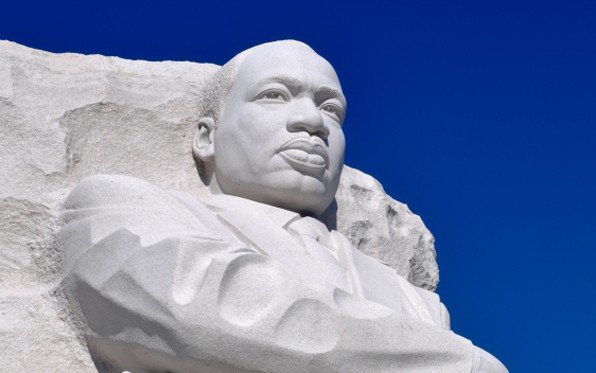
Words (a poem): Martin Luther King Jr. Day Reflection 2016

Every year I sit down to write my reflection before Martin Luther King, Jr Day. Usually my thoughts begin to form weeks ahead of time, swirling in my head as I process what I feel and need to say. This year, I struggled.

The ugliness of racism, which is always there, feels more overwhelming to me this year. There is so much to say and yet, if I’m honest a part of me thinks “what’s the point?” and another part feels that there are more expressions, explanations, indictments, rebuttals and real-time reactions than ever before which say so eloquently what I wish to express. I am stuck with wondering “what else do I have to add?”

I thought about just making a list of links to the wonderful pieces that are out there already; works that have moved and challenged me around race and racism this year. And then I started to think about the purpose of blogs, essays, prose and how we use language and the refrain “words” kept coming up for me. What is the purpose of a word? So, this year my reflection comes in a different form- a poem of sorts- as I try to untangle within myself my own motivations for these reflections and to understand a society damaged by racism, generally, and anti-blackness, specifically .

Words are not adequate
Words are too small
(11 pt font)
Words cannot capture
-are never enough to encompass the feelings, emotions and impact
(racism)
Yet words are powerful
Words have meaning
Words are both
weapon
and
balm
Words reveal dreams
(told by a King)
and expose dreams unfulfilled
(“a dream that one day this nation will rise up, to live out the true meaning of its creed”)
Words empower movements
(#blacklivesmatter)
and demagogues
(#trump4president)
They tell stories
(I wish I never knew)
of names
(I wish I never heard)
(because then they’d be living their stories, present tense, not exist as names spoken, past tense)
like Tamir Rice, Michael Brown, Sandra Bland
(you know the list keeps going and going, right?)
Words assign
identity
(black boy) (“whose size made him look much older”)
culpability
(“and who had been warned his pellet gun might get him into trouble that day”)
blame
(“it was reasonable to believe the officer who killed the boy believed he was a threat”)
excuse
(“a perfect storm of human error”)
Words distract
(why aren’t we talking about black on black crime?)
Words describe
the mundane
(playing in the park, walking down the street, driving a car)
the profane
(shot in less than 2 seconds, left in the street for 4 hours, found dead in her cell)
the obscene
(every comment section , every news article)
They wrap around each other twisting, obscuring, knotting
(truth and lie) (opinion and fact)
Words maintain
(status quo) (white supremacy)
They indict
exonerate
justify
(race) (constructed)
They defend and dismiss
(but he’s a good person)
They explain
(good and bad are not relevant) (systemic racism)
Words express
pain
and anger
and love
and frustration
and joy
and
Words cannot
explain the unfathomable
make us forget
bring them back
Words are inadequate
Words are powerful
(words are all I have today)

Stories: Martin Luther King Day Reflection 2015

This year’s reflection is about stories.

The stories we are told, the stories we aren’t; the stories we believe and the stories we dismiss; the stories we tell ourselves, the stories we tell children; the stories that are myth and the stories that misunderstood.

Stories we tell ourselves.

I think we tell ourselves stories all the time. Narratives we weave to explain and understand the world around us, especially other people.

Like this.

Imagine you’re sitting at a stop light and you don’t realize that the light has turned green. The person in the car behind you honks to let you know the light has turned green. You get defensive; maybe say aloud “Have some patience!” (Or perhaps something more colorful).

Another day you’re at a light and the light turns green and the car in front of you doesn’t go immediately. Do you “have some patience!”? Or, like me, do you get frustrated and perhaps tell yourself a story about the incompetence of the person in front of you. “Not paying attention- too busy texting to drive.” Or, if you’re honest, maybe your story is a little more specific: “those teens are always texting”; “that old lady needs to get off the road”; “those people need to learn to drive”…

We tell ourselves stories all the time, usually without thinking about it. And I think the stories often reveal our biases (explicit and implicit) and certainly our assumptions. Sometimes it’s just a story or a fleeting thought known only to ourselves. Sometimes we catch ourselves as the story forms – recognize the bias – and rewrite it in the moment. And sometime that story has larger implications-
an applicant not hired, a student suspended, a gun fired.

Those are the stories I’m thinking about today.

Stories that are representative
We celebrate and honor Martin Luther King, Jr. as a singular, extraordinary man. But we also honor the people and the movement, the struggle and the sacrifice he represents. He has become more than just his own story. This past year, we have come to know the stories (or rather the tragic end of the stories) of Mike Brown, Eric Garner and Tamir Rice. They are both singular and representative of the anger, frustration, fear and anguish of an unjust system. These men became more than just their death. And their stories must be told- no shouted- because there are so many similar stories never even whispered.

Stories that are “color blind”
But there is one story about race we hear all the time. I believe that one of the most destructive race stories told in the United States is the ideology of being colorblind. This myth is often told through the misinterpretation (at best) of King’s words: “I have a dream that my four little children will one day live in a nation where they will not be judged by the color of their skin but by the content of their character.” Not judging someone by their race is not the same as not seeing their race. Colorblindness erases an important part of many people’s identity. And ignores reality. And is paralyzing.

If we believe the mythology of colorblindness, then we cannot actually talk about race even in the most basic sense. And we certainly cannot address racism. My eyes are brown; my hair color changes depending on the dye I use; my skin is white. If you don’t see those things, you don’t see me. Ignoring people’s identities is not progress. Progress is seeing a person for their full self and treating them with respect and dignity. Progress is recognizing the ways that racism is present in our systems and addressing them. Progress is telling the story of racism in this country with nuance and texture and truth.

Stories that are “good” or “bad”
Stories are often presented as dichotomy, either someone is a good person OR they are bad. This is especially true in narratives about racism. For example, if we name our concerns about racism in law enforcement, then we are interpreted as saying that all police officers are “bad.” The obligatory counter story “there are good police officers, too” is recited. But when it comes to bias (and most issues really), good and bad are completely beside the point. It doesn’t take a person of ill will to perpetuate racism. “Good” police officers have bias. “Good” teachers have bias. “Good” (fill in the blank) have bias. Goodness (whatever that means) is not some sort of protective anecdote for racism. That narrative is completely unhelpful. Certainly there are officers who are undeniably engaging in racist practices and there are police chiefs who are taking real leadership on these issues. But the real story is about systems. And this “story” about goodness is, simply put, getting in the way of addressing those systems. As Kareem Abdul-Jabar wrote recently: “The police aren’t under attack. Institutionalized racism is.”

Stories that we tell children
The stories that we tell the children in our lives about race and racism usually depend on, well, race. The child’s race and the adults. Kids of color often get “the talk” about race. Or rather, many talks about race. This is often not a choice for their parents, even when it’s desperately not the story they wish to tell. Yet, white children with white parents often don’t get told a story at all.

I know I’ve written about this before. But it is something that comes up all the time: truly concerned white parents of white kids who worry that talking about race will make their children racist (see: Stories that are colorblind). The thing is that I’ve never heard a parent say “It is important to us to raise our children in our religious faith tradition, but we’re not actually going to teach them what we believe, we’ll let the media do that.” Or “I want my child to be polite and use ‘please’ and ‘thank you,’ but I’m not going to actually tell them that.” I’m truly not being snarky; I just want to make the point that we instruct our children all the time on what’s important to us. And when we don’t explicitly talk to them about race and racism, that story is loud and clear.

Stories that lack nuance
We don’t seem to like nuance in this country. Or at least the media certainly doesn’t. And that’s a problem when we’re trying to address systemic racism. The story of racism in our country in nuanced. Racism isn’t just bold and blatant; it’s implicit and subtle. It’s not just white supremacists; it’s white supremacy. It’s not just black and white; it’s the common and distinct experiences of discrimination for all people of color, bi-racial and multi-racial people. Racism is intrepid, and shape-shifting, concrete and ephemeral, personal and institutional, embodied in individuals and in systems.

Stories that are unfinished
The story of Martin Luther King is not just biography, it is myth- he is larger than life.

Embedded in the myth is the idea that we’re done. That he had a dream and now we can celebrate. The real story, all around us, is that we’re not done. Yes, the civil rights movement accomplished many things. However, we still have attacks on voting rights, we still have unequal and disparate treatment in schools, we still have injustice in the criminal justice system, we still have brutality and bias in law enforcement and we still have a dream to deliver.

Today, let’s remember and celebrate the man, the myth and the movement. But this story is not written. It is being written. This story is not about the past. This story is about today. And we are the authors of that story.

Martin Luther King Day Reflection 2014

The U.S. Department of Justice and the U.S. Department of Education just released an important document: guidance on school discipline that reaffirms what many of us have been concerned about for years- the disproportionate discipline rate of students of color and its contribution to what has been called the “school to prison pipeline.” It is no small thing to read a document from the federal government which states in plain language that “discrimination in school discipline is a real problem. ” It included data from the Civil Rights Data Collection (CRDC) that found African-American students without disabilities are more than three times as likely as their white peers to be suspended or expelled from school and that “the substantial racial disparities of the kind reflected in the CRDC data are not explained by more frequent or more serious misbehavior by students of color.”

This is important. This is recognition of the systemic nature of racism and its real consequences.

This makes clear that it is an issue that spans the country: across states, across both big cities and small towns, across school districts, across economic status.

And it is important because it lays bare the myth that racism is simply an act of “bad” individuals. No one can suggest that every school system across the country is made up of hardened, blatant racists who are intentionally discriminating.

No, we must understand that racism is much more pernicious than that.

Let me share a story:
A few months back I was visiting S at school during lunch. It was the end of the lunch period and the first grade children were lining up. The first child in line was a young African American boy. He was a little fidgety, but no more than any other first grader trying to stand still in line. The lunch monitor turned around, locked in on him and his fidgety body, and told him to get out of line and to sit at a table for the kids who “got in trouble.” He tried to protest that he didn’t do anything. The lunch monitor ignored his protests, just as she had ignored the two white girls talking and giggling behind him in line. The teacher came and his “behavior” was reported and once again he attempted to protest and was rebuffed. And then, as he realized it was futile, his shoulders slumped, his head dropped and a look of resignation settled into his face. It was a resignation that it didn’t matter what he said and it didn’t matter that he knew he hadn’t done anything wrong. It was resignation that things were often not fair, not for him. I watched his face transform in a moment from indignation to resignation and it broke my heart.

Now, some of you will read that paragraph and immediately recognize the scene. You can see the moment and the look. And you understand.

Others will read it and the disagreement or justification will start in your head. The “buts” of argument. “but… you don’t know that was about race.” Or “but… being a lunch monitor or teacher is hard, they miss things sometimes.” Or “but… that’s just one situation.”

I don’t blame you. You’re right. I can’t prove to you that race was the heart of that encounter. And the lunch monitor? She’s not a “bad” person. In fact, if asked I am positive that she would protest and truly believe that race was not a factor. And it was just one situation, one moment.

The reality is that those single moments can almost always be “butted” away. And they are. All the time. Unless the presence of racism is blatant, it is so easy to dismiss (and even sometimes when it is blatant, we still do our best to deny).

And that’s how you have undeniable evidence of racial disparity in our schools without the recognition of individual acts of racism or identifiable racists.

And that’s because as a country as a whole, and in our media, we don’t understand racism in its complexity.

Racism is systemic, institutional, pernicious, deadly, engrained and unconscious. It is hypocritical and inconsistent: sometimes sneaky, sometimes bold, both subtle and blatant. It is empowered when ignored and emboldened when denied. (And so it thrives).

And racism is stubborn and entrenched because it requires deliberate engagement to be dismantled.

That’s why the Department of Education’s Guidance Letter is both so important and so meaningless. It states the issue so plainly but its remedy is not. Because, until everyone connected to the school system is willing to look hard at themselves and ask truly tough questions, and until each school staff person is willing to entertain the notion that they are engaged in the perpetuation of a racial inequity, whether conscious or not, those statistics will remain.

But this issue isn’t just about school teachers or staff. And it’s not an indictment. I am privileged to know and work with many dedicated, reflective educators committed to equity, including those at S’s school.

No, it’s about all of us. The entire community has to hold ourselves accountable, examine our own prejudices and ask ourselves hard questions. Who do we see as the “troublemakers?” How do we define “good” schools? How do you talk about “those kids” or “diversity”? Do we explain away racial issues with vague notions of good intentions? Will we be honest with ourselves? Will we require others to be honest as well?

If we do not, then we have chosen resignation that racism will continue to systematically disenfranchise our kids of color.

And ultimately here’s the point: the boy in the cafeteria? He was right. He didn’t do anything wrong. But I did. I watched it and didn’t speak up for him. I didn’t say anything because I felt uncomfortable interfering. I told myself it wasn’t my place.

That, too, is how racism is perpetuated.

So I am holding myself accountable.

This MLK Day, I refuse to be resigned.

Martin Luther King Day Reflection 2013

Last weekend I was in Nashville attending a board retreat for a non-profit. On Sunday afternoon, I shared a taxi to the airport with two other board members. As soon as we got into the taxi, the driver started talking a mile a minute, talking about himself and punctuating every couple sentences with “seriously” and “no kidding, ladies.” I smiled at “L” the person sitting next to me and was secretly happy I wasn’t “P,” the “lucky woman” who was sitting up front in the passenger seat next to the loquacious drive.

“P” and I got out at the airport together. I said something about the taxi driver being a talker. P responds “My kids would have told me to stop asking question.” Then she paused and said “I think some people just want to be heard…in all these years there has never been a time when I didn’t learn something.” Then we said goodbye and went to on our way to our respective gates.

But her words had me rooted back in that moment. What she said was so simple and so powerful. “Some people just want to be heard.” I was humbled.

I started to think about who gets heard. And it made me think about the upcoming Martin Luther King, Jr. holiday and what it represents. Part of King’s importance was that he was an amplified voice for so many others who were not heard. He was the voice of those oppressed by our country’s long history of racism, segregation and Jim Crow. His voice was really the fervent chorus of thousands, and through him, an entire movement was heard. And that voice continues to echo today – continuing to remind us of the meaning and importance of the Civil Rights Movement.

But who are the people who are not heard today, even through a representative voice? In our country (and certainly the world) there are so many people and groups who, no matter how loud they raise their voice, are not heard. People ignored because they lack the agency of voice. People dismissed because of race, class, status, sexual orientation, gender identity, ability, religion, age or other aspects of their identity. People we choose not to hear.

We know that there absolutely is power in being heard. There is also power in truly hearing.

There are so many obstacles in our society and in our lives which interfere with listening. The constant, dismissive accusation that anyone who tries to address race in the public sphere is playing “the race card” stops us from hearing. The ubiquitous use of “media round tables” where everyone stakes out a side instead of putting stake in dialogue stops us from hearing. A media driven by profit, instead of human interest, and that chooses what is deemed as “noise” and what is worthy or attention, keeps us from hearing. The equation of money with power in politics prevents us from hearing. Our own hubris and privilege, which interferes with human connection, also interferes with our ability to hear. The absence of empathy shuts out the voices we most need to hear.

So, this Martin Luther King Jr. Day, I share the simple, powerful wisdom of my colleague “P” and ask: who will you hear and whose voice will we collectively demand be given agency and amplification?

For my part, as a starting point,

I will hear the anger expressed by my friend and colleague, Jason, who is fiscally impacted every pay check by a federally-codified discrimination (Defense of Marriage Act) which says that, as a gay man, he must be taxed for the privilege of providing his partner with medical insurance while straight couples are not. I honor his voice and recognize the daily impact of inequality.

I will hear the pleas of the high school student, Cesiah Trejo, who spoke at a press conference for the ASSET bill on Tuesday. Cesiah has lived in Colorado since she was a young child and cannot fulfill her dream of attending college, because she is undocumented. I will honor her voice and raise my own to pass the ASSET bill in Colorado and the DREAM Act nationally.

I will hear the choked voice of young men of color trapped in devastating mass incarceration policies resulting in African Americans being imprisoned at nearly six times the rate of whites, and Latinos at nearly double the rate.

I will hear the stories of a taxi driver in Nashville who immigrated to the United States in the seventies and wants to be heard. I will honor his voice by asking you to do the same.

Martin Luther King Day Reflection 2012

For many, Martin Luther King, Jr. Day is a day to reflect not only on Dr. King’s legacy and accomplishments but also to celebrate the accomplishments of the civil rights movement and all its heroes. It is also a time to reflect on “how far we’ve come,” and hopefully, where we still need to go.

For me the where we need to go is a very important part of the reflection. In the past year, I have been thinking a lot about my responsibilities to help my daughter understand race and racism in age appropriate ways. I want to make sure that she (and now, the baby on the way) understands the history and the legacy as well as our role in continuing to fight against bias and for civil and human rights. As adults, I think the tendency is to think that’s a conversation for when she’s older, but I know that she is (and has been) forming her understanding of race throughout her young life.

I have been thinking about this even more this year, I think in part because of some emails that I received last year after my MLK reflection about teaching S about everyday heroes.

One email I got was from a dear friend from college who identifies as Africa American and has two young children who are also African American. She spoke very frankly about the additional struggles of raising her children and the ways that race and racism play out in their young lives and how hard it is for her.

I also received a few responses from good friends who identify as white and have young white children. They were concerned about how to raise the topics of race, discrimination and racism (either historically or present-day) for fear that if they introduced talked about different races or racism that it would actually foster racism or introduce those ideas to their children.
To me these different responses, all sincere and heartfelt, show clearly the way that race and privilege play out in the United States. For my friend of color, there was no choice. Race and racism are always present and she and her spouse have to engage their children in those conversations regularly, whether they want to or not. White parents, by and large, have a choice about whether to discuss race (or feel they have a choice) and, as a result, don’t talk about race with their white children. In fact, parents of color are three times more likely to discuss race than white parents and 75% of white parents never, or almost never, talk about race. (NutureShock, p. 52)

And that’s what has been on my mind. How can we get more white parents of white children (I am using that distinction purposefully, because not all white parents have white children and vice versa) talk to their children about race. I write this partly out of selfishness, because I want and need allies in this conversation and because sometimes it feels really lonely (not because I think I’m the only one struggling with this or thinking about this, but because, just like the actual conversations about race, I find there is very little discussion amongst parents about having race conversations… if that makes any sense).
So this year, I am especially writing to and for people like me: white parents of white children (as well as anyone who has white children in their life).

Here’s the thing, we live in a society where generally there is very little conversation about race. And many people hold a sincere belief that if we don’t talk about race or differences then that in and of itself will end racism (the colorblind philosophy).

In my work and in my personal life I hear things like “my kids don’t even know what race is” or “my kids don’t see color” often. Well, of course, kids do see color. One of the first things we teach our children is to distinguish by color- sort yellow from red from blue and distinguish items using color as a cue (“my yellow truck, “that blue blanket,” etc.). Why would we assume that kids would stop distinguishing color when it comes to people? Children do in fact see that different people have different skin color. What I think most people really mean to convey in these statements is a sincere belief that the social construction of race has not yet seeped into their children’s heads- that their children don’t make judgments about race. I get that. I want to believe that about my own children.

But if we never talk with them about race, how will we know?
In fact, I’ll take it one step further and say that if we don’t talk with children about race then we can assume that they are in fact making assumptions based on race.

Now, at this point, people might say “what?” or “not my child!” or stop reading because now I’m impugning your child.

However, the research in child development makes it clear. And from a gut level, I think it makes sense. Has your child ever come to you and started talking about something that you know you never have talked about or introduced? (Like when S started talking about Justin Bieber. I know that didn’t come from us). Our kids are getting a lot of messages from everywhere- friends, media, school, environment, pictures, etc. And through those vehicles, there are a lot of messages about race. A lot! And usually not the messages we want them to get.

So, if we’re not providing counter-messaging, then…

Studies show that leaving kids to figure it out on their own often results in the very bias and prejudice white parents are worried about. You might have seen some of these studies yourself- they recently did a series on CNN (see link below). And the parents were always so surprised that their white child showed racial preferences and internalized messages that their race is better… but then they admit that they never talk to their kids about race.
Dr. Phylis Katz, who has conducted a large number of research studies on race attitudes in young children (like from 6 months of age young and up) has written: “During this period of our children’s lives when we imagine it’s most important to not talk about race is the very developmental period when children’s minds are forming their first conclusion about race.”

So why don’t we talk about race? In addition to the concern that we’ll inadvertently introduce racist attitudes, there is another reason. Put plainly, we’re uncomfortable. We don’t know how to talk about race and are afraid that we’ll say the wrong thing.
In the book NutureShock, Po Bronson and Ashley Merryman address this exact topic in the chapter “Why White Parents Don’t Talk about Race: does teaching children about race and skin color make them better off or worse.” (It’s a great book! ). In the chapter, they highlight an interesting study in Austin, TX where white parents were recruited for a study about racial attitudes in children. Once in the study, parents were asked to explicitly talk to their children about interracial friendships (saying things like “Some people on TV or at school have different skin color then us. White children and Black children and Latino children often like the same things even though they come from different backgrounds.” And so on). Well, several of the parents dropped out rather than talk explicitly about race, even thought they knew it was a study about racial attitudes. Then, it turned out that several of the parents who stayed in the study didn’t really follow the instructions. They talked with their children but in a more vague way, saying things like “everybody’s equal” or “under the skin, we’re all the same” – general phrases that didn’t specifically call attention to racial differences. These kids didn’t show any improvement in racial attitudes after the study. But for the few parents who really did talk openly about race, all of those kids greatly improved their racial attitudes. (p. 47-52)

So, it turns out that not only do you have to talk about it, but you have to talk about it explicitly. I know this was an important reminder to me, I have definitely used the vague “everyone’s equal” language with S before.

So, children need explicit conversation. And they need to be engaged, even when they say something that embarrasses us. Even though our instinct may be to shush the child or ignore them. Because then, we’re back to silence again and the message that the topic is unspeakable (and therefore, bad). I’m sure we’ve all been there- our child loudly points out some form of difference and we cringe. (It happened to us recently around age differences. We were talking about a teacher and S said “She’s an old lady.” Our first instinct was to say “S, that’s not nice.” And then we had to circle back and say “You’re right, people are all different ages and she is older than your other teachers. And people don’t usually like to be called “an old lady” like that.”)
There’s so much more interesting research and studies to share, but I have to remember that not everyone finds this stuff as fascinating as I do. Instead, I posted some links and resources below- things that I’ve found to help me have those conversations with S.

The bottom line, and what I am focused on this MLK day, is that I have a responsibility to address race, not only with adults, but the young people in my life. And when I avoid doing so, I am making a choice out of privilege. A choice my dear friend from college does not get to make.

So, here’s my reminder to myself:

Feel uncomfortable. Do it anyway.
Not sure what to say? Start talking.
Scared of what they’ll ask (‘cause they could ask anything)? Dive on in.
Feel too hard? Keep on trucking.

I hope that you’ll join me and we can support each other and share our successes and failures.

Not just on Martin Luther King, Jr. day, but it’s a good day to start (or continue or renew our efforts).

Sending my love and wishing you a reflective day,
Beth

Research, articles and videos:
The Bronson/Merryman Newsweek article: http://www.thedailybeast.com/newsweek/2009/09/04/see-baby-discriminate.html

Talking to children about race

http://library.adoption.com/articles/young-children-and-racism.html
The CNN study I mentioned:
UPDATED: AC360 Series: Doll study research
Panel discussion: Kids and race

Tips and resources:
http://www.adl.org/education/miller/q_a/answer8.asp?sectionvar=8
http://www.parenting.com/article/5-tips-for-talking-about-racism-with-kids

Click to access how_to_be_an_anti-racist_parent.pdf

Martin Luther King Day Reflection 2011

A couple of months ago, my daughter S and I were driving in the car, talking about superheroes. I can’t remember how the topic came up, but superheroes seem to be a popular topic of conversation at this age, at least in my experience with four year olds. Before I tell this story, I should mention that S is a pretty practical and pragmatic four year old. For example, when we went to see the musical Shrek, at intermission she said “that isn’t really Shrek, it’s an actor in a costume.” (Although I know she really wanted the dragon to be real). And when I try to invoke a current favorite character to inspire desired behavior (as in, I think Buzz Light Year really likes to eat all his dinner), she will tell me “Mommy, Buzz Light Year isn’t real.” So with that context, back to our conversation about superheroes: We’re discussing superheroes and their various abilities and which ones we would want (flying, super speed, etc.). Given the described aspects of S’s personality, you know I wasn’t surprised when she announced “I’ll never be a superhero and don’t have super powers.” However, I did take notice of how her declaration came out like a sigh, it sounded like resignation. She was disappointed such a thing wasn’t possible.

This moment continued to stay with me and as I’ve reflected I have come to the conclusion that my job as Mommy is to redefine the word “hero” so that she sees her potential, so that she believes she can be a hero- not the kind that can fly or shoot webs out of her hands, but a real, every day, flesh and blood, maybe nobody even knows your name but they feel the impact of your actions, kind of hero. As Martin Luther King, Jr. Day approaches, it is the perfect time to remember that there are lots of those kinds of every day heroes in our world. For me, MLK Day serves not only as an opportunity to remember and honor a great civil rights leader for his contributions and ultimate sacrifice, but also as an opportunity to recognize all of the people who were part of the Civil Rights Movement as well as those who continue that legacy today. I believe that King symbolizes the people of the movement, everyone who marched, who was jailed, who was beaten, who raised their voices instead of their fists and who sacrificed to fight oppression and discrimination.

The world knows Dr. King. And there’s a good chance many of us may recognize the names of some of the other leaders in the movement- John Lewis, Julian Bond, Medgar Evars, Diane Nash or Ralph Abernathy. But do we know Genevieve Houghton, Charles Person, Jim Zwerg or Hank Thomas? These last four names represent just a few of the over 200 people who became known as the Freedom Riders- fighting to integrate the buses and bus stations of interstate travel in the South.

And do we know Ezell Blair, Jr., Franklin Eugene McCain, Joseph Alfred McNeil or David Leinail Rochmod? They were the four college students who sat at a Woolworth’s lunch counter and engaged in the first sit-in of the Civil Rights Movement.
Or do we know Sheyann Webb? In 1965, she was eight years old when she joined 600 marchers who set out across the Edmund Pettis Bridge to march from Selma to Montgomery, Alabama. Instead, they were stopped and beaten by state troopers. The day would become known as Bloody Sunday.

Whether we know their names or not, they are all heroes. They certainly didn’t have super powers- their bodies were not protected from the blows of injustice- but they did have the power of their courage and their conviction. No, they were not super human, but rather flesh and blood examples of our full human potential.

They are just a few of the “we do not know their name, but we feel their impact” kind of heroes.

They made the world we live in today possible.

So S will learn about them and learn to redefine the qualifications for “super hero.” And she will also know that heroes are not just in history. There are heroes all around us every day.

Heroes like the seven individuals I had the privilege to meet last night at the Colorado Martin Luther King Humanitarian Awards. These honorees are incredible individuals who have dedicated their lives to fighting injustice and addressing inequalities; individuals who choose to be heroes every day. (And just so you know their names, the award winners were Dr. Robbie Lee Powell Bean, Lifetime Achievement Award winner, Alisha Brown, Frank Lucero, Lena Lawson Gibbons, Alice Powell Langley, Coach Laurence Tarver and Loretta Richardson).

And so S also will learn that heroism is not an accident but a choice we make.

I am so fortunate to know many such “heroes by choice”- friends, colleagues and community members who choose to work towards something greater than themselves. They are people who understand that it is not enough to mark how far our country has come, but where we still have to go; people who, with great intention, continue to fight for civil rights for everyone and who work to end inequities.

No fancy cape or special tricks, but heroes nonetheless. And S will know them, too.

But yet I know that it’s not an easy job to redefine “hero” in a society where celebrity outshines contribution, where vitriol makes more noise than reason and where hatred seems to regularly take center stage. And so, in anticipation of Martin Luther King Day, I ask a simple question. I pose this question to myself and I share it with you. How will you choose to be a hero today? tomorrow? And the next day? You may not have your own comic book, but I promise we will feel the impact.

I would like to end this short Martin Luther King Day reflection by sharing some of Dr. King’s words- two quotations that speak to me in connection to this defining of heroes.

“A time like this demands great leaders. Leaders whom the lust of office cannot kill; leaders whom the spoils of life cannot buy; leaders who possess opinions and will; leaders who will not lie; leaders who can stand before a demagogue and damn his treacherous flatteries without winking. Tall leaders, sun-crowned, who live above the fog in public duty and in private thinking.”
A Realistic Look at the Question of Progress in the Area of Race Relations, St. Louis Freedom Rally, April 10, 1957

“On some positions, cowardice asks the question, ‘Is it expedient?’ And then expedience comes along and asks the question, ‘Is it politic?’ Vanity asks the question, ‘Is it popular?’ Conscience asks the question, ‘Is it right?’ There comes a time when one must take the position that is neither safe nor politic nor popular, but he must do it because conscience tells him it is right.”
Remaining Awake Through a Great Revolution, March 31, 1968

Martin Luther King Day Reflection 2010

On New Year’s Eve, my friend Lisa asked me what my New Year’s Resolution was for 2010. I told her that I didn’t make New Year’s Resolutions; it just wasn’t something I did. She replied that she knew that anyone could decide to make positive changes any time throughout the year, but that she liked New Years Day because it was a reminder – one day – to remember to stop and take stock and think about what she wanted to change. And that concept resonated with me. As I thought about it, I knew that that was what Martin Luther King Day is for me.

It is a day to stop and reflect on what has been accomplished towards King’s Dream and to check the balance on what King called the “promissory note,” the riches of freedom and the security of justice promised to all people in the U.S. It’s a reminder – one day – to both look back at the strides of the civil rights (and there have been many), as well as the steps that still have not been taken (and there are many yet to go). In many ways, it is a time for resolutions. Typical New Years resolutions require someone to think about what he/she doesn’t like (weight, life balance, debt) and make a commitment to change it (exercise, fewer commitments, budget). I think this framework works for Martin Luther King Day as well- to examine where we, as a country, have not met our promises and to resolve to change those injustices, to see where civil rights are not yet a reality and resolve to fight until they are won.

Resolutions are typically more successful when people work on them together (friends exercise together, a whole family resolves to stick to a budget) and I think that holds true as well. On Martin Luther King Day we honor not only the man, but the movement he represents. We honor the legacy of all the people who have worked together to make changes. That’s why I walk every year in Denver’s Martin Luther King, Jr. Day Marade (combination of march and parade) – to be a part of something much bigger than myself and to feel a part of a larger commitment. And that’s why I write this letter every year- to reach out and connect to others, to feel that through each word read, letter by letter, we are joined. I don’t know that I’m always successful in my goal, but the act of connection and joining is important for my own resolve.

So, in the spirit of collective resolution, this year I thought I’d make a list of what should not be- a list of where I believe this country, and the world, has not yet met the promise of civil rights, the places where discrimination and marginalization still thrive. Implicit in making the list is the commitment (the resolve) to work on changing each inequity, to fight for the humanity and dignity of each person still feeling the weight of oppression. This is not a complete list, by any means, but it’s a start. It is a list that will exist long past next year’s MLK Day, but we must persist. It is a list that demands the collective commitment. So, in offering this list I ask- What speaks to you? What’s on your list? What will you decide to change? What is your resolution, not just for this one day (which may be just a day off), but for everyday?

And if that kind of commitment feels a little heavy, before the list, let me offer you three sources of inspiration.

Nicholas Kristof, journalist and author whose work I very much admire, said (I’ve paraphrased a little) “If the whole feels like too much. If you think I could never address all of that, just pick a slice. What slice can you address? We can all take a slice.”

Miep Gies, who helped hide Anne Frank and her family from the Nazis for two years. She died recently, at the age of 100. During her life, she resisted being made a character study of heroism for the young: “I don’t want to be considered a hero,” she said in a 1997 online chat with schoolchildren. “Imagine young people would grow up with the feeling that you have to be a hero to do your human duty. I am afraid nobody would ever help other people, because who is a hero? I was not. I was just an ordinary housewife and secretary.” (Thank you to my colleague, Kelly, who led me to this wonderful quote.)

S, my three your old has her own take. When a task looks hard, she tilts her head and put her hands up in a shrug and says “I can try it? I can try to do it.”

So, I say, what will you try? What slice will “ordinary you” address?

As for ordinary me, as I mentioned, I’m recognizing MLK Day by taking stock and making a list of what should not be, and then working to change each inequity, slice by slice.

My (incomplete) list of what should not be:

The color of your skin should not determine whether you get a job, get a loan, or rent an apartment, but it often still does.
More than 50 years after Brown v. Board of Education, educational segregation should not be status quo, but it is. In fact, nearly three-quarters of black & Latino students attend predominantly “minority schools.” Although black, Latina/o, Asian and Native American students make up only two-fifths of the total U.S. school population, they typically attend schools where the vast majority of students are from their own racial groups.

Your social class or your neighborhood should not impact your access to quality education, medical care or other resources, like healthy food options, but it does. And the choices we make are determined by the choices we have.

The color of your skin should not impact your access to quality education, medical care or other resources, like healthy food choices, but it does. As just one example, there are four times as many supermarkets in white neighborhoods than in neighborhoods that are predominantly people of color.

Who you love should not determine whether you can marry and receive the 1,138 federal benefits and rights given on the basis of marital status, but it does. Even in the five states where same sex marriage is legal, same-sex couples do not gain the benefits of these federal laws, rules and regulations.

Your gender should not determine your literacy rate or whether you go to school, but in many parts of the world, it does.

Your gender should not determine whether you are given lifesaving medical treatment, but in many parts of the world, it does.

Your class status should not determine your life expectancy, but, in fact, your position on the class pyramid is the single strongest predictor of your health and life expectancy.

The United States should not have the highest infant mortality rate and highest child poverty rate of all rich countries, but it does.

Your gender should not equate to your pay, but it does. Women’s salaries are still 80% of men’s for the same hours and same work .
Sexual orientation should not impact the ability for talented, skilled individuals to serve this country, but it does. In fact, since 1993, 10,000 people have been discharged from the military as a result of Don’t Ask Don’t Tell.

The homelessness rate in New Orleans should not have doubled since Hurricane Katrina, but five years later it has.

It should not be legal for you to be discriminated against because of your gender identity and expression, but if you identify as transgender or gender queer, in almost all states you can be.

Genocide should not be happening in our world today, but is. And the places it occurs should not impact the world’s response, but it does.

Finally, the sexual transgressions of a “celebrity” athlete should not garner more media attention than any of the above issues, but we all know they do.

What’s on your list?

Martin Luther King Day Reflection 2009

A few months ago I was walking with my daughter S, her hand in mine, and I thought “her little 2 year old hand feels like nothing else I have ever touched.” The softness (still baby soft and smooth) and the weight (so light, yet solid lying in my hand) do not feel like anything else. In writing, metaphors or similes are used to describe- “soft as,” “feels like,” “just as”- but there are no metaphors, no approximation, for the feeling of her little hand in mine.

Similarly, I believe there is nothing else- at least in my life experiences- that felt like the space between hope and reality that many of us inhabited between August and November 4th. The suspended space- of possibility, of hope, of “do I dare believe this could happen?”- held in bated breath; and then, at 9:00 pm (Mountain Time) on November 4th a release of breath and tears and confirmation: yes, hope is suddenly a reality. A reality that had been held in question- could it? will we?- until it just was. Yes, we did. The recognition of the reality that we elected the first African American, bi-racial person to the office of President is still a feeling that I cannot fully put into words; there are no metaphors, no approximation, for that feeling either.

So much has been, and will be, written or spoken by people much more eloquent and consequential than I about these events, that I confess I feel somewhat silly writing this. Just this week, I have heard both the Mayor of Denver and the Governor of Colorado speak on this very topic. But as many of you know I have written these Martin Luther King Day reflections for the past 9 or 10 years. This year’s Martin Luther King Day’s celebration is inextricably linked with the inauguration and all that it symbolizes. And there is so much that has been floating around in my mind over the last few months, both formed and echoed by a national conversation. So, please indulge and forgive me for repeating what I know will be expressed by people all across the country.

Beyond the indescribable personal feeling about the election, the reality is that the citizens of the United States did something no other country has: a white majority elected a person of color to the country’s highest office. As we approach Martin Luther King, Jr. Day, this single fact gives much cause for reflection and rejoicing. I think it is incredibly poignant that not only did Obama accept the presidential nomination for the Democratic Party on the 45th anniversary of the March on Washington, but that he also will become the President of the United States the day after we honor Dr. Martin Luther King’s birth date and the legacy of the Civil Rights Movement. Clearly, our country’s civil rights struggles are directly tied to the reality of Obama’s election. Indeed, “Obama’s ascension to the highest office in the land is possible only because so many men, women and children – abolitionists, civil rights advocates and their allies – stood up for justice across the centuries” (Jennifer Holliday, Teaching Tolerance Web site).

In February, I had the amazing, humbling highlight of personally meeting some of those people who stood up for justice, the Little Rock Nine. I had the great honor of providing transportation for one the nine, Jefferson Thomas, and his wife. Mr. Thomas is truly one of the kindest and most inspiring persons I have ever had the privilege to meet. 50 years ago, as high school students, these nine individuals literally risked their lives to gain their right to an equal education, by integrating Little Rock High School in 1958. Jefferson Thomas’ and his fellow Little Rock Nine’s sacrifice, are part of the legacy of civil rights heroes- both those known and unknown- who made November 4th and January 20th possible. It is truly awesome (as in awe-inspiring, not the 80’s vernacular for cool) that in his lifetime Jefferson Thomas went from being turned away from Little Rock High School by the National Guard to witnessing, next Tuesday, an African American man take the oath of office for the President of the United States. How rare and wonderful that someone lives to see the impact of his actions magnified tenfold. As Dr. Beverly Daniel Tatum, President of Spelman College and author, wrote after election night, “When the announcement of Sen. Barack Obama’s victory came, the cheers and tears in the swell of the largely African-American crowd at Spelman were mirrored in the faces captured by news broadcasters at the multi-racial, multi-ethnic, and multi-generational gatherings in Grant Park in Chicago, Times Square in New York, and at the gates of the White House in Washington. Surely it was a night to remember. Regardless of political affiliation, we can all take pride … and relish the social significance to this and every generation of the success of President-elect Obama, the first African American man to overcome this most symbolic of racial barriers, just 45 years after Rev. Martin Luther King Jr. articulated his dream that one day his children – Barack Obama’s generation – would be judged by the content of their character, not the color of their skin.”

To be sure, Obama’s election was about so much more than race. To boil this election and Barack Obama’s victory down to solely race does not do him justice, but to ignore the historic significance of the election does not do it justice either. We cannot deny the reality that many thought would never happen in their lifetime; we cannot deny the power of seeing an African American First Family; we cannot deny the struggle for racial justice that has brought us to this place. And as a white person I cannot forget, that even as a shared national experience, I do not truly understand what seeing Barack Obama take the oath of office on Tuesday will mean for my friends of color.

Like Dr. King, President-Elect Obama is a leader of a movement for change in our country. Like Dr. King, President-Elect Obama is representative of something larger of the great promise of our country. Like King, Obama is a symbol of both what has been accomplished and what still remains to be done. In his historic speech on race last spring, Obama cautioned, “I have never been so naive as to believe that we can get beyond our racial divisions in a single election cycle.”

And so on Martin Luther King, Jr. Day we certainly have much to celebrate- a very bright moment in our nation’s very mottled history of race and racism. And we cannot be complacent, believing that this holiday only commemorates the past and “once was;” because the movement still has much to accomplish. Our country still has work “to rise up and live out the true meaning of its creed- we hold these truths to be self-evident, that all men are created equal” (King, “I Have a Dream”) The day is about both celebration and continued commitment to the cause.

As long as Obama is seen not only as exceptional (in the way that any person who is elected President is certainly exceptional), but also as an “exception to…” then our work is not done. As long as people simultaneously feel pride in voting for Obama, and still talk about “those people” or “that neighborhood,” then work still needs to be done. As long as there is still racial discrimination in housing, employment, and the justice system, then we have not fully reached King’s dream “of freedom for the whole human race and in the creation of a society where all men can live together as brothers, where every man will respect the dignity and the worth of human personality” (King, “The American Dream,” 1961). As long as children of color are disproportionately affected by poverty, poorly funded schools, malnutrition, unemployment, etc. then the work of the civil rights movement must continue.

The march forward must continue for all people who are be forced to live on the margins of society, because of ethnicity, economic status, immigration status, sexual orientation, gender identity, and disability. For me the history of this election is sadly diminished by the fact that this election was not a victory for the LGBT community and their allies. At the same time that a majority of people voted for a person of color as President, a majority of citizens in four states also voted to deny equality to gay people either by denying (Arizona and Florida) or taking away (California and Arkansas) their civil rights. So, yes, there are still civil rights that must be won. When people are blatantly discriminated against because of their identity, we have not fulfilled the promise of our country. No matter what attempts are made to couch or explain- as we have clearly seen throughout history, prejudice can be given many “logical explanations”- these votes were about discrimination.

Also, immigrant rights may have taken a back burner in recent national conversation, but the issue is absolutely on fire across the country. There are many policy issues which need to be addressed regarding “the best way to reform America’s immigration system but the debate has been framed by vitriolic anti-immigrant – and particularly anti-Latino – rhetoric and propaganda,” even in the in the mainstream press and created an atmosphere in which hateful rhetoric has become routine. (ADL, http://www.adl.org/civil_rights/) As one example on the legal front, The New York Times reported that “last week, Attorney General Michael Mukasey, declared that immigrants do not have the constitutional right to a lawyer in a deportation hearing, and thus, have no right to appeal on the grounds of bad legal representation. Mr. Mukasey overturned a decades-old practice designed to ensure robust constitutional protection for immigrants” (January 13, 2009). This is a much larger issue than I have space to address in this reflection, but it absolutely one where over the next few years our country will show whether it will truly live up to its ideals. We also cannot forget that the United States is inextricably linked to an international community- genocide, war, loss of precious human life- remind us of the ongoing fight to bring change and peace across the world.

And still, we should take a moment to relish. The excitement and hopefulness of the election and the next few days can serve to renew us. I am emboldened by the knowledge that change can be won- not just in an election- but in the fight, in all the many steps over many years that individual people took to get to this moment in history.

This Martin Luther King Day and the inauguration which follows fills me with a sense of something very unique – the weight of history as it happens- the sense of knowing that these particular moments have great impact; they will, in fact, change our world.
Like the particular weight of S’s hand on mine, this weight feels wonderful- and is much too fleeting. These moments will become a memory, a story that we will try to articulate in the future, never quite able to. There are no words to fully explain a feeling unlike any other.

As I hold S’s hand when we march in Denver’s Marade on Monday, what I hope she will absorb from these moments- moments which she will be told about as her life’s lore, because while she is living in it, she is too young to share in the collective memory- is that she absorbs the feeling of it. That she’ll never know the time when a black man couldn’t become President; that over the next four years as she begins to have formative memory, her first President will be Barack Obama is amazing to me! I cannot know yet how that formative reality will impact her outlook on race and identity. But I fervently wish that she will absorb all the sense of hope and possibility of this time and the reality that change does happen; that she will know in some deep, indescribable way that she can be, can do, can change anything. That she knows the power of her touch. And more importantly, that she feels a responsibility to reach out into the world.

Indeed, I hope that is the feeling we all gain.

Martin Luther King Day Reflection 2008

It was 9th or 10th grade- and all the girls in my class (P.E. class, I think) were “treated” to a guest speaker. I don’t remember what the woman’s actual job title, but she was there to share her expertise regarding make-up and skin care. I do remember that she told us the rules for putting on make-up: 1) don’t put foundation on with your fingers, only with a sponge and 2) always apply all make-up in upward motion. You see, “a downward motion pulls the skin down and we already have gravity to do that. The upward motion goes against gravity and that is better because- it helps fight wrinkles!” I distinctly remember thinking there was something rather strange about giving 14 year-old girls wrinkle prevention tips. Here we were young women just entering high school and already we were being instilled with the fear of getting old and, worse, looking it.

Today, I find the whole experience disturbing on many levels. Foremost, I think back in dismay at the opportunity missed. Of all the guest speakers and all the ways that teacher could instill a lifelong lesson- was wrinkles really the best she had?

Sure I learned many things in high school and had some good teachers. However, I also learned very little about civil rights or what it means to have civic responsibility. There were no meaningful lessons- or guest speakers- about a different foundation all together- the foundation of our nation’s values or the care with which that foundation should be treated.

This is not intended as an indictment of schools. There are many wonderful teachers (like my Mom, a retired teacher) instilling important skills and values. I also find that there are more of those “foundational” lessons being taught today (I am happy to part of an organization that contributes to that). My dismay lies in the larger picture– if our society spent as much energy and money on critical issues like poverty and justice as we do on beauty, celebrity and youth, can you imagine the impact we could have?

I can imagine it. I had the pleasure of participating in an event last night that showed the impact of the committed individual. The Colorado Martin Luther King Humanitarian awards honored eight amazing individual whose energy is turned to the important issues of the world. For example, teen Elisa Sagehorn, who at 16 years old spent her time organizing all aspects of a telethon which raised thousands of dollars for the new hospital in her small town; or Randle Loeb who, himself homeless at one time, has become an incredible advocate for the homeless in our state. Or, Lt. Les Perry who has spent his 28 year career with the Denver Police Department trying to build break down cultural barriers and build trust between citizens and officers. At the end of the ceremony, Lt. Perry said to me “When you try to write the script of your life, you don’t ever include events like these.” And that’s exactly why he was honored. Because he wasn’t seeking honor, he was seeking service.

All eight honorees have made an enormous impact on their communities and they all had many different motivations (I’m pretty sure wrinkle prevention wasn’t one of them) – passion, anger, responsibility and even self-interest. Self-interest. I think we often see this as antithetical to doing service or doing good. But I think it’s an importantly powerful motivator for service. I want everyone to find the “I” in this work- to see themselves in the fight. For example, I have many personal stakes in social justice work. I want S to grow up in a society that will not treat her worse just because she’s female or better just because she’s white. I want my city to be a diverse place, where working class people still have a place to live, without worrying about whether the tax base will support “good” schools or services. I want the school system to be academically strong and equitable. I want my friends who aren’t white or straight or middle class to be free from harassment no matter what part of the city they are in. These are things that I want for myself and my family. Selfish of me, perhaps. But I’m ok with that.

Rather, I think it’s a problem that people don’t see themselves in the issues. They don’t see how they are personally affected; don’t see that they have a stake in the fight. But the structures which support discrimination affect us all.

One example: there is a lot of concern about the state of our economy today. One of the major factors in our economic downturn has been the slump in the housing market. A significant piece of the downturn in the housing market has been the staggering increase in defaults on subprime loans. Many studies and reports have shown that U.S. mortgage lenders targeted people of color and people with low incomes in recent years as the “best candidates” for subprime home loans. Racism and classism are very much an element of our economy state. Yes, understanding our economy and all the different aspects which impact it is complicated, but the point is very clear. When we take a close look at structures in our society we can see how discrimination impacts all of our lives. We all have an “I” in social justice.

My dear great grandmother (Granny Foster) passed away yesterday at 106 and 16 days old. Her beautiful wrinkles tell of all she experienced in her lifetime. It is amazing to think of how different the United States is since she was born in 1902. She was a pioneer in her own right- went to college when women didn’t go to college and instilled the importance of education in all her family. And she was witness to much advancement in our society and many amazing and important milestones in social justice – when she was born women didn’t even have the right to vote! To be sure, there have been many positive advances in terms of human and civil rights in country. And, to be sure, there are many improvements and changes which still need to be made.

And both of these reasons are why I write in honor of Martin Luther King Day every year: to remember and celebrate the sacrifice and commitments of those who came before and to be reminded of the work that needs to be done. And I am optimistic about that work, perhaps more so than in a long time, because people are making change in groundswell movements across the country and the world. The awardees last night are just eight examples. The hundreds of people who responded to the inequality of the justice system in Jena, LA are another. The thousands who are working to end genocide in Darfur and putting pressure on China to end their economic involvement in the Sudan are still another. They are all finding the “I” in the fight for social justice.

Another reason I am optimistic is that we can work in so many more ways than when Martin Luther King was marching from Selma to Montgomery. We can march on the internet highway; we can petition virtually; we can make ourselves heard through YouTube. We can spread our message, contact our representatives and make our voices heard in powerful ways. The in-person social action is still incredibly important, but we also have immeasurably more and easier access to successful political tools. And that also means that there are fewer excuses for inaction.

The theme for Martin Luther King Day is “A Day On, Not a Day Off.” Many organizers and activists are trying to hold onto the real purpose of this holiday (strangely it wasn’t created so that advertisers could have another marketing tactic). I write this reflection every year to try and keep the meaning of the holiday in the forefront of my life, as well. But regardless of what I do on Monday, even more important to me is that it’s a yearly reminder to make every day a “day on” in some way, as much as possible. And there are so many ways to serve, so many ways to make change. As Martin Luther King, Jr said “everybody can be great because anybody can serve.”

And as I say: service won’t fight wrinkles, but it will make your life more beautiful.

Love, Beth

Martin Luther KIng Day Reflection 2007

This Martin Luther King, Jr. Day is obviously a special one- S’s first. And I have been thinking a lot about one of my responsibilities of a parent; how to raise S with an understanding of the world that includes compassion, passion and kindness. How will we explain all the “isms” and the inequities? How will we raise her to honor all the differences in the world? But right now she’s too young and there are other parental responsibilities in the forefront; S trusts her Dad and me to take care of her in more basic ways- food, shelter, love, and touch. She looks up at us with those big eyes that seem to say “I know you’ll take care of me” and my first thought is I want to give her the best. And that gives me pause, the idea of “best.” Let me explain.

I’m in a book club and this month the chosen book was Mountains Beyond Mountains by Tracy Kidder. It was the perfect book for me to read right now, and gave me pause and offered a different perspective. The book tells the story of a real-life doctor named Paul Farmer, and his organization called Partners in Health (PIH), which seeks to bring all forms of medical services to places of extreme poverty or need, like Haiti, Peru and Siberia. But foremost PIH works in Haiti, an island of over 8 million people, just over 1,000 miles from the United States (half the distance from New York to California) and one of the most impoverished countries in the world. In one way, Mountains Beyond Mountains is a story of one man and his incredible determination to fight disease and treat people against major obstacles. He is fueled by the absolute belief that extreme poverty does not diminish people’s worth. In another way, the book is a portrayal that makes plain the terrible poverty that exists, the many causes of that poverty, and the disease and illness which result, in part, from that poverty. Many of the diseases which wreck havoc and kill many in Haiti, like tuberculosis, are very treatable and virtually no longer exist in the United States. (I’m afraid I don’t truly do the book justice, I encourage you to read it for yourself).

While Haiti is a place of extreme poverty, many of the forces that have created poverty there exist in different forms to create the relative poverty that exists in the United States. Martin Luther King, Jr. understood how class and socio-economics impact many social justice issues. He often wove the realities of economic inequities into his writings and speeches. In his essay “A Testament of Hope” (1968) he writes it is time that we stopped our blithe lip service to the guarantees of life, liberty, and the pursuit of happiness. These fine sentiments are embodied in the Declaration of Independence, but that document was always a declaration of intent rather than reality. There were slaves when it was written, there were still slaves when it was adopted; and to this day, black Americans have not life, liberty nor the privilege of pursing happiness ,and millions of poor white Americans are in economic bondage that is scarcely less oppressive.
That economic bondage still exists today as evidenced by the number of people in poverty in the United States. PovertyUSA (http://www.usccb.org/cchd/povertyusa/povfacts.shtml) reports that the official poverty rate in 2005 (the most current year for which figures are available) was 12.6 percent and the total number of people in the United States below the official poverty thresholds numbered 37 million. Since 2000, the number of poor Americans has grown by more than 6 million. In 2005, the number of people living in extreme poverty, that is, with incomes below half the poverty line, remained the same at 15.6 million people. The number of Americans living in extreme poverty remains the highest level on record, since data first became available in 1975.

For a more global perspective, the inequities of wealth are made clear by the miniature earth project (www.miniature-earth.com) which turns the population of the earth into a small community of 100 people, keeping the proportions we have today. This community would look like this….
 43 live without basic sanitation
 18 live without an improved water source
 6 people own 60% of the entire wealth of the community
 13 are hungry or malnourished
 7 are educated at a secondary level
 18 struggle to live on $1 per day or less
 53 struggle to live on $2 per day or less
 If you keep food in a refrigerator, your clothes in a closet. If you have a bed to sleep in and a roof over your head, you are richer than 75% of the world.

So, I do not believe that we can honor MLK day and fight racism, without also looking at classism (I think it’s fitting that January is also National Poverty Awareness Month). To be clear, I do not think class “trumps” race (an argument which I believe is often made in order to ignore racism.) I believe both are important and connected elements in the inequities which still exist.

I’ve personally been thinking a lot about class the last few years, and struggling with my own feelings and understanding of what it means to be “middle class.” Though I have a roof, refrigerator, bed and closet, I certainly don’t feel “rich.” Like many people our age, Michael and I are worried about “making ends meet,” and now, supporting S. And yet, it is clear that we do have wealth of a certain kind. We have shelter, work, health insurance, (not to mention “basics” like clean water and good sanitation) and, of course, lots of stuff. Stuff that we say we “need” while knowing that is a word defined quite loosely. In some ways, I think that being in each higher socio-economic class means getting to define more things as “necessities. “
And that brings me back to that idea of “best.” Because I know that best isn’t really a finite, concrete place but a moving point determined by available choices. Choices determined by the accident of birth; I mean the accident of where one is born and in what situation. With S’s birth, I am even more aware of the benefits and privileges that I have and can now give to my daughter. That “best” is full of meaning and responsibility.

I write this reflection every year in order to reflect on my own internal struggles. And I’m grappling with fully recognizing the privilege that comes with class and to better understand the impact of class on so many other facets of my life, and on our society. I struggle with the complexities and I am struggling now with how to truly convey my feelings on paper. There is so much more I could write and some much more to learn.

So where am I going with this? Simply, that my struggle is part of my own growth, but it can’t stop me from trying to make change.
Mountains Beyond Mountains makes plain many plights the world faces and the effect of how they build on one another- the impacts of war and political strife, genocide, disease and, of course, poverty. These are factors and problems (for lack of a better word) that seem insurmountable, but that individual people like Dr. Farmer are working to chip away at everyday. But why aren’t more people doing the same? In fact, many people view Dr. Farmer and others in his organization as unrealistic and even foolish. I think that is because the ills seem so large and devastating, they can be overwhelming. The “big picture” can cause inaction, and subsequently, rationalization for that inaction. Questions like “How can we possibly fight tuberculosis, which kills 5, 000 people a day in places without basic medical facilities?” or “How can I, one person, stop genocide?” become “I can’t possibly do that, so why am I trying?” Dr. Farmer would describe this inaction as ambivalence, which he defines as “as the often unacknowledged uneasiness that some of the fortunate feel about their place in the world.”

The singer, songwriter John Mayer has a hit song in 2006 called Waiting for the World to Change. It is often referred to as something of my generation’s What’s Going On?- that is, a musical social commentary on all the ills of the world, in particular an unjust war. But instead of the angst or anger that sings forth from Marvin Gaye’s missive, Mayer’s anthem feels more like the ambivalence Farmer describes. His song gives a sense of “it’s not right, but the sources of power seem too large and unreachable, and it makes me uneasy and I can’t imagine how to fix it, so I’ll just see if something changes on its own.” I certainly hope that isn’t the call of my generation or the ones that follow me.

I hope that we have not lost the necessary fire or fight for change, because we know that social change does not happen on its own. Martin Luther King, and the many individuals involved in the Civil Rights Movement whose spirit he has come to represent, understood this. The forces of structural racism were large, powerful and oppressive; yet, individuals decided to fight despite the cost or the odds.

Farmer calls this “fighting the long defeat” It sounds pessimistic, but I think it’s actually realism combined with the most amazing form of optimism. He can look at the big picture and see how difficult it is, seemingly impossible, to bring health care to one of the most impoverished countries in the world. Yet, he works one patient, one family, one illness at a time. Counting each individual impacted, each patient treated a victory. Each person as worthy. And with this philosophy he has, in turn, made a huge impact and helped change the big picture for the better as well, as did all those who stood up during the Civil Rights Movement.

And that is how I want to approach the world. What I want to encourage on this important day: for each of us to contribute and make a difference in the face “of the long defeat.” Whatever cause speaks to you, in whatever ways small that you can. That is what I want S to learn and to truly believe- that she can make a difference in a thousand tiny ways and they will add up, they will count, and she will make a difference.

With love and hope,
Beth