
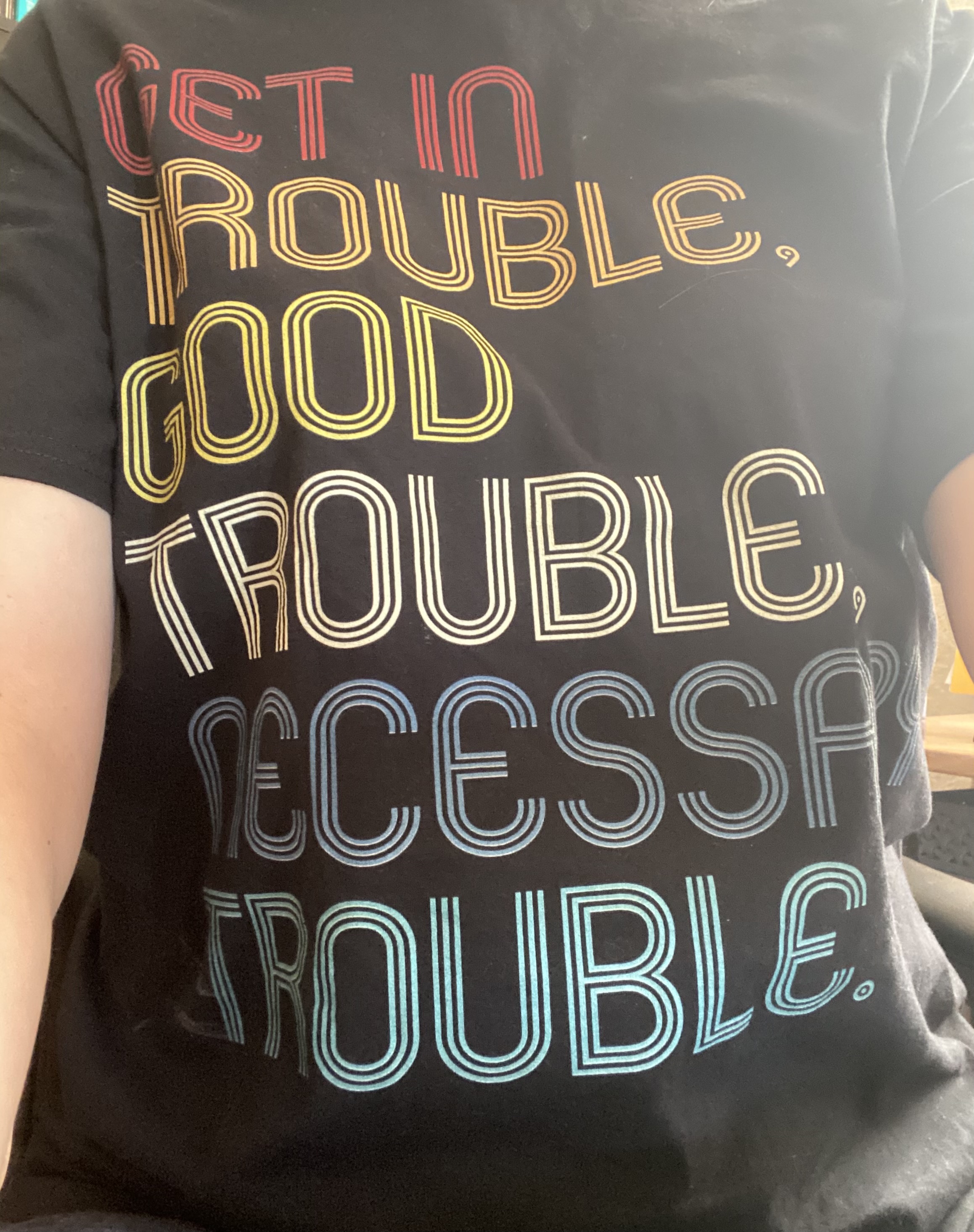
The other day, I was talking to my friend Esther about the strange feeling of living through history. I know that technically everything becomes history and yet our current time is one that we know will be written about in history books. And I know that I personally am having a hard time processing all that it means amidst the mundane aspects of life – homework and dishes and grocery shopping – that still require attention.
We are all carrying this heaviness of simply living in the midst of all that has transpired just in the last year: a President impeached (twice), a global pandemic, the renewed reckoning of our country’s racial injustice and terror after the murder of George Floyd and far too many more, and now we are faced with the fragility of democracy with an attempted insurrection and heightened fear as we ready for the inauguration. I confess I do not know how to make sense of it all.
And so I’ve been trying to anchor myself in the things that feel more tangible; in places where I feel some sense of control. I reread my reflections since 2016 and found themes around how I’ve tried to make meaning of our current time and engage in action in the past four years. And then, about a week ago, a friend on Facebook, Nimita, shared this:

And it helped crystallize for me one of those tangible anchors and choices I can make right now. I can choose to actively engage with other white folks to address our racism, rather than stay comfortable in my “bubble.” So this year’s post is for us white people, specifically. I am focusing on guiding reminders to keep me focused on dismantling racism in myself, in others and in our institutions.
Passive pronouncements are just that… passive
We know (and were reminded this week) that social media is a powerful tool. It also fools us into thinking we’re “doing” more than we are. Passive pronouncements of our values, like “If you support racism, we’re not friends,” are still passive. And there is nothing more passive than telling someone “unfriend me.” That’s not even doing the work of actively hitting the unfriend button. And it certainly doesn’t do anything tangible to address racism. But it may delude us into thinking we’ve “taken a stand.” The same is true offline when we simply stop talking or engaging with others. Or when we join in calling out other white people and taking comfort in the fact that “we’d never do anything like that” or “we are appalled by that behavior.”
Motivation matters
Especially in the last four years, I have seen and heard, as well as thought to myself, countless versions of “I told them the facts. I told them they’re racist and they didn’t change. I’m done.” When my motivation is to change someone else, I almost always end up dissatisfied with the results. I have set myself up, because -simply put- I don’t have control over others.
What I can do is offer an alternative, another perspective. If my motivation is to engage, my energy is different: I ask questions and seek to understand (not agree, but understand). I can recognize and engage with the cognitive dissonance and the resistance in others, when I remember that I’ve experienced them myself.
Seeing myself
White people, we are really good at playing the “I’m a good white person” game and trying to distance ourselves from other white people. But we must not be fooled; this is just another version of “rugged individualism” that maintains white supremacy. Separating myself from other white people serves my ego, not the cause.
When I find myself in that space, I will try to see myself in the other person and ask myself: How am I like them? When have I felt that way? In many ways, dismantling racism is an attempt to dismantle our own foundation. The desire to protect oneself, to take a defensive posture is understandable. I didn’t get to any place in my journey on my own; I should not expect others to do so either.
Reframe accountability
As a society we don’t seem to know how to hold people accountable outside of a purely punitive context, without opportunity for repair or change. I think that’s why so many of our reactions are some version of “you’ve done bad, I banish you.” I am trying to reframe accountability and find ways to hold people accountable while holding on to their humanity as well as my own. That means being clear about the impact of their words or actions without denigrating them as people. It means requiring taking responsibility for their impact while leaving opportunity to repair. It means remembering that “we are all more than the worst thing we’ve done.” (Bryan Stevenson).
Expect failure
If my fortitude is predicated on success, I will not persist.
In addition to reframing accountability, I must also look at what it means to hold myself accountable – to continue to make moral choices regardless of the immediate outcome, to persist through risk and failure. Sixty years after the Civil Rights Movement, I think Dr. King’s legacy is often condensed into his successes. And yet the reality is that there was never any certainty that the movement would be successful. For me, Dr. King’s legacy is in the continued effort, despite failures, despite risk.
When I was in graduate school, my mentor and advisor, Mari Strombon Johnson once told me – referring to equity and inclusion training- “one person has to hear something 32 times before it will stick.” Which means that there has to be 32 “messengers” willing to deliver the message to that one person. Thirty-two wasn’t a scientific number, but rather a reminder that we had to be in it for the long haul. Her point was that if you’re the 32nd messenger, the payoff is immediate, with the recipient responding with some version of “I get it” and it is easy to feel successful. More often than not, we will be messengers #1 – 31, delivering the message, getting resistance, offering a different way and trusting someone else will continue after us. There is no “payoff,” only hope that it will come. This also helps to keep me from slipping into the dreaded posture of “white savior” and a misplaced and dangerous belief that I alone must (and can) take it all on.
Intentional engagement
For many of us, social media algorithms create echo chambers that manipulate us into thinking that everyone is already with us. Add in the bubble creator of a different kind- COVID- and we may be even more isolated. In these cases, rather than think “well thank goodness I don’t have those friends,” we may need to be more intentional and take additional effort to engage.
I also have taken note and understand the critique by some BIPOC (Black, Indigenous, People of Color) that white people are wasting our time with proverbial “racist uncles” and should focus instead on systemic change. I think it’s a both/and: we can engage with individuals one-on-one and choose to focus on systemic changes where we can have influence. We can address systems through our places of work, schools, religious institutions and organizations where we volunteer. There is no limit to the places where we can ask hard questions, challenge and hold leaders accountable, take risks, and address racial inequities. In many cases, a big part of that work is engaging with other white people. We do not need to compartmentalize, nor should we. However, we can and should be intentional about where we can have the most impact. None of us can do it all. That doesn’t mean we shouldn’t do something.
I’m not naive. I am not suggesting that it is as simple as talking to someone. There are real challenges and a strong hold of disinformation, stridency and division. AND I also know that if as white people we turn away and simply wash our hands of other white people, while patting ourselves on the back in our circle of other “anti-racists,” we are most certainly not engaging in anti-racism.
Dr. Martin Luther King Jr. Day is one day. For me, it is a moment for reflection and recommitment. This year it is a day to pause and consider the places where I falter. And remind and recommit myself to the ongoing work that remains, every single day. I hope you will join me.
 bethreflects